National News
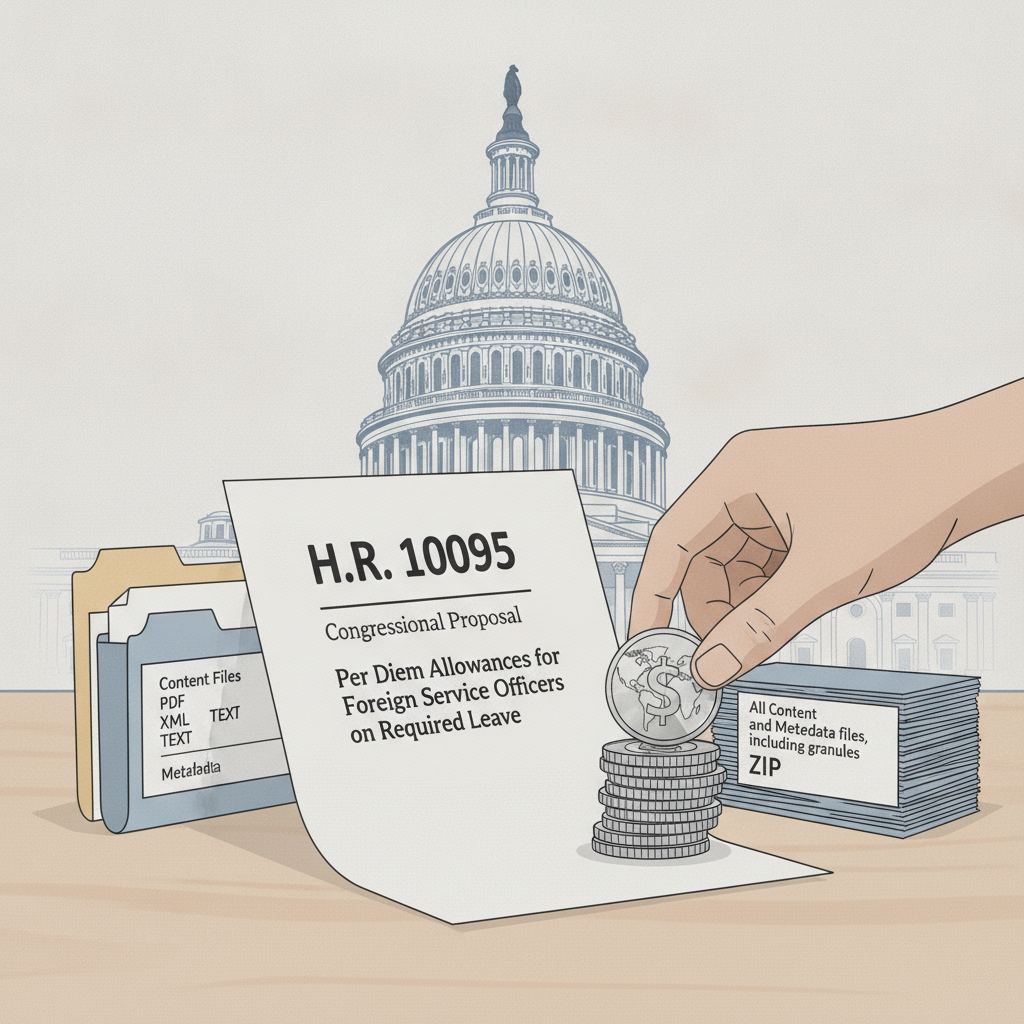
Congressional Proposal H.R. 10095 Seeks Per Diem Allowances for Foreign Service Officers on Required Leave
Content Files PDF XML TEXT Metadata download Descriptive Metadata (MODS) Preservation Metadata (PREMIS) All Content and Metadata files, including granules ZIP

Last updated:
Key points
Congressional Proposal H.R. 10095 Seeks Per Diem
- H.R. 10095 was introduced in the House of Representatives to amend the Foreign Service Act of 1980.
- The bill proposes granting per diem allowance eligibility to Foreign Service members during required leave periods.
- The measure will undergo committee review to evaluate workforce impacts alongside federal travel spending and taxpayer accountability.
NewsWK — Federal lawmakers have introduced new legislation aimed at restructuring expense allowances for United States diplomatic personnel, targeting statutory travel rules that govern Foreign Service officers when they return stateside for mandatory leave periods. The measure, designated as H.R. 10095, proposes direct amendments to the Foreign Service Act of 1980 to authorize per diem eligibility during required leave assignments.
Why it matters here
For taxpayers across the country, federal personnel compensation and statutory travel expenditures remain critical areas of congressional stewardship and accountability. The diplomatic corps represents the United States at embassies and consulates worldwide, operating under distinct statutory compensation frameworks compared to domestic civil service employees. When Foreign Service officers return to American communities on federally mandated home leave, their housing, transit, and daily subsistence costs have historically been subject to specific administrative restrictions.
H.R. 10095 directly impacts how taxpayer dollars are allocated for government travel and subsistence. If enacted, broadening per diem eligibility could alter federal outlay projections within the State Department’s operational budget while easing the out-of-pocket logistical burdens placed on diplomatic families transitioning temporarily between foreign postings and domestic stays across American cities and towns.
Understanding Mandatory Leave and Federal Allowances
Under the Foreign Service Act of 1980, members of the Foreign Service stationed overseas are statutorily required to complete periodic “home leave” inside the United States. Designed to ensure that career diplomats maintain ongoing familiarity with American culture, civil society, and local conditions, this mandatory leave requires personnel to reside within the United States after completing overseas tours.
However, the financial mechanics of these transitions have long drawn debate within federal personnel policy circles:
- Per Diem Standards: Federal per diem rates, typically calibrated by the General Services Administration (GSA) and the Department of State, provide fixed daily reimbursements for lodging, meals, and incidental expenses during official travel.
- Statutory Gaps: Historically, standard annual leave and certain forms of mandatory home leave have not carried full domestic per diem coverage, requiring personnel to personally absorb short-term rental costs, transportation, and daily living expenses in U.S. jurisdictions where they may not maintain a permanent residence.
- Proposed Adjustment: H.R. 10095 specifically addresses this gap by amending the 1980 statute to make per diem payments available during required leave periods, recognizing the mandatory nature of these orders while establishing clear eligibility criteria under federal law.
Legislative Path and Fiscal Oversight
As an introduced bill, H.R. 10095 must proceed through the standard legislative committee process in the House of Representatives before reaching the floor for a full vote. Key panels, such as the House Foreign Affairs Committee, routinely examine measures adjusting diplomatic compensation to evaluate both workforce retention and overall fiscal impact.
Lawmakers reviewing the proposal are expected to evaluate cost estimates from the Congressional Budget Office (CBO) to determine how the expanded travel allowances would affect federal discretionary spending. Fiscal conservatives and government accountability advocates regularly emphasize the necessity of clear caps, rigorous audit trails, and strict oversight mechanisms on all federal per diem programs to ensure public funds are expended efficiently.
As Congress reviews the operational requirements of the Department of State, H.R. 10095 represents a targeted effort to modernize personnel statutes enacted more than four decades ago, balancing workforce stability for diplomats abroad with disciplined federal spending back home.
This article was produced with the assistance of AI and reviewed by our editorial team.