National News
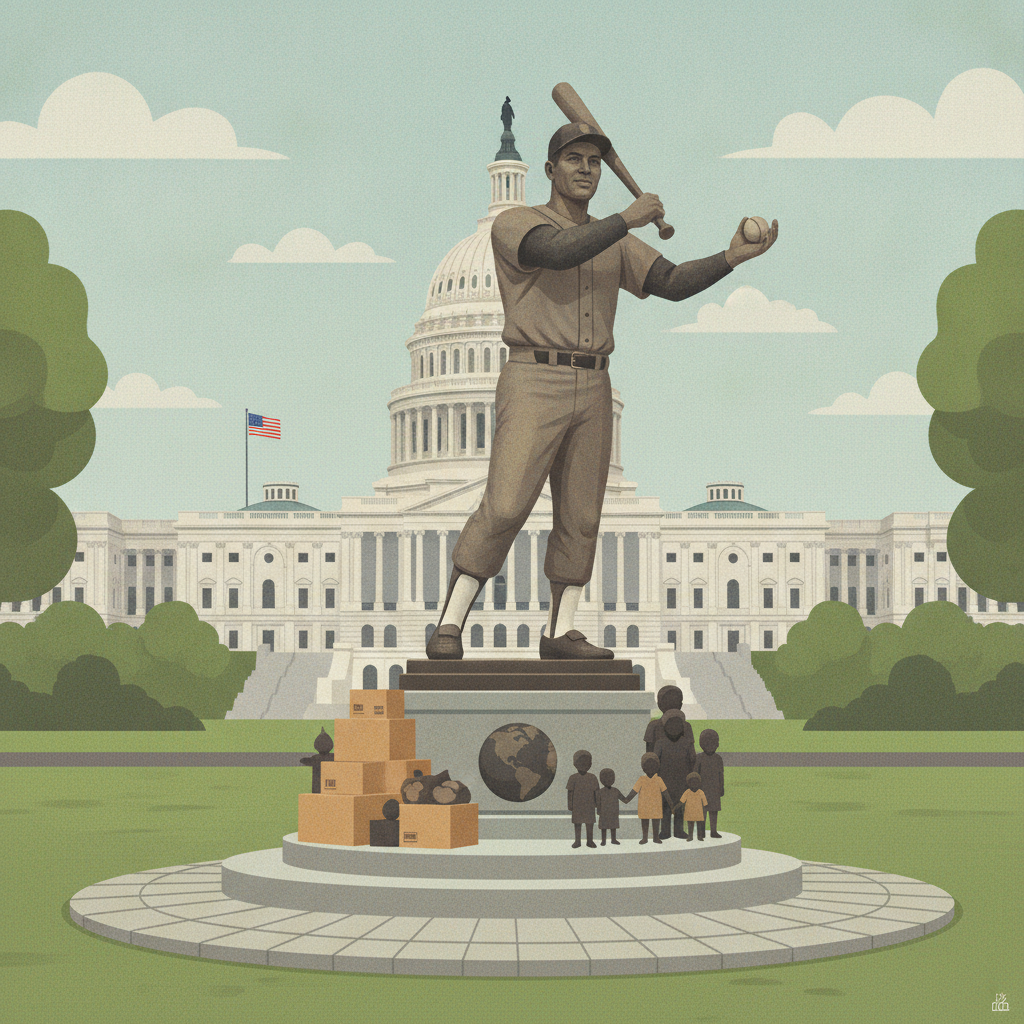
Congressional Legislation Proposes Capitol Statue to Honor Baseball Legend and Humanitarian Roberto Clemente
Content Files PDF XML TEXT Metadata download Descriptive Metadata (MODS) Preservation Metadata (PREMIS) All Content and Metadata files, including granules ZIP

Last updated:
Key points
Congressional Legislation Proposes Capitol Statue
- Legislation introduced in the House (H.R. 10121) directs the placement of a statue honoring Roberto Clemente in the U.S. Capitol or on Capitol grounds.
- Clemente, a Hall of Fame baseball legend and U.S. Marine Corps Reserve veteran, died in 1972 on a humanitarian relief flight to Nicaragua.
- The measure seeks to permanently honor Clemente’s athletic achievements, patriotism, and dedication to charitable service in the nation’s capital.
NewsWK — Federal lawmakers have introduced new legislation in the House of Representatives seeking to place a commemorative statue of baseball icon, military veteran, and humanitarian Roberto Clemente within the United States Capitol complex or on its surrounding grounds.
The bill, titled H.R. 10121, directs Congress to obtain and install a permanent likeness honoring the Puerto Rican-born Pittsburgh Pirates star. If enacted, the measure would enshrine Clemente’s legacy alongside some of the most influential figures in American history, recognizing both his hall-of-fame athletic accomplishments and his supreme sacrifice during a charitable mission abroad.
Why it matters here
For millions of Americans, public monuments in the nation’s capital serve as an enduring testament to civic virtue, individual perseverance, and self-sacrifice. Placing a statue of Roberto Clemente on Capitol grounds elevates an American sports hero whose life exemplified dedication to community, faith in service, and devotion to duty.
Clemente remains a unifying cultural and historical figure across the United States, particularly within Hispanic and Puerto Rican communities, as well as throughout sports traditions nationwide. Beyond his athletic prowess, Clemente’s direct approach to private philanthropy and his willingness to risk his life for disaster victims offers a timeless model of personal responsibility and charity rather than reliance on governmental apparatus.
A Legacy of Athletic Excellence and Military Service
Born in Carolina, Puerto Rico, in 1934, Clemente rose from humble beginnings to become one of Major League Baseball’s most revered players. Over an illustrious 18-season career with the Pittsburgh Pirates from 1955 to 1972, he amassed exactly 3,000 hits, secured four National League batting titles, earned 12 consecutive Gold Glove Awards, and led his team to two World Series championships, earning World Series Most Valuable Player honors in 1971.
Alongside his professional athletic career, Clemente demonstrated deep patriotism and civic duty by enlisting in the United States Marine Corps Reserve during the 1958-1959 offseason. He served on active duty at Parris Island and Camp Lejeune, maintaining his reserve status until 1964. His military commitment reflected a core belief in duty to country, a characteristic that defined his approach both on and off the field.
Humanitarian Sacrifice and Lasting Influence
Clemente’s life came to a tragic and heroic end on December 31, 1972. Following a devastating 6.3-magnitude earthquake in Managua, Nicaragua, that killed thousands and left hundreds of thousands homeless, Clemente personally organized emergency relief flights filled with food, medical supplies, and essentials.
After learning that prior aid shipments were being intercepted by corrupt local officials, Clemente boarded a four-engine cargo plane on New Year’s Eve to ensure the supplies directly reached the victims who needed them most. The overloaded aircraft suffered mechanical failure and crashed into the Atlantic Ocean shortly after takeoff from San Juan, Puerto Rico. Clemente’s body was never recovered.
Following his death at age 38, the Baseball Writers’ Association of America waived the traditional mandatory five-year waiting period, electing him posthumously into the National Baseball Hall of Fame in 1973. Major League Baseball also renamed its annual philanthropic recognition the Roberto Clemente Award, presented each year to the player who best exemplifies sportsmanship, community involvement, and team contribution.
The Path Through Congress
The placement of artwork and statues within the Capitol is tightly regulated by federal statute and overseen by the Joint Committee on the Library alongside the Architect of the Capitol. While the National Statuary Hall Collection primarily features two statues donated by each of the 50 states, Congress periodically passes specific statutory authorizations to commission and place distinct memorial statues honoring extraordinary Americans across the Capitol building and grounds.
H.R. 10121 has been introduced and referred to the appropriate House committee for initial review. Lawmakers will determine the statutory mechanisms for acquiring the statue, selecting a sculptor, and designating an appropriate location within the Capitol complex to honor one of America’s greatest athletic and humanitarian champions.
This article was produced with the assistance of AI and reviewed by our editorial team.
Sources
Related: What you need to know about the flesh-eating New World screwworm
Related: Sanctuary Policies Block Federal Jail Transfers as ICE Ramps Up Enforcement Across U.S. Communities
Related: About
See a typo? Report it here.