Washington
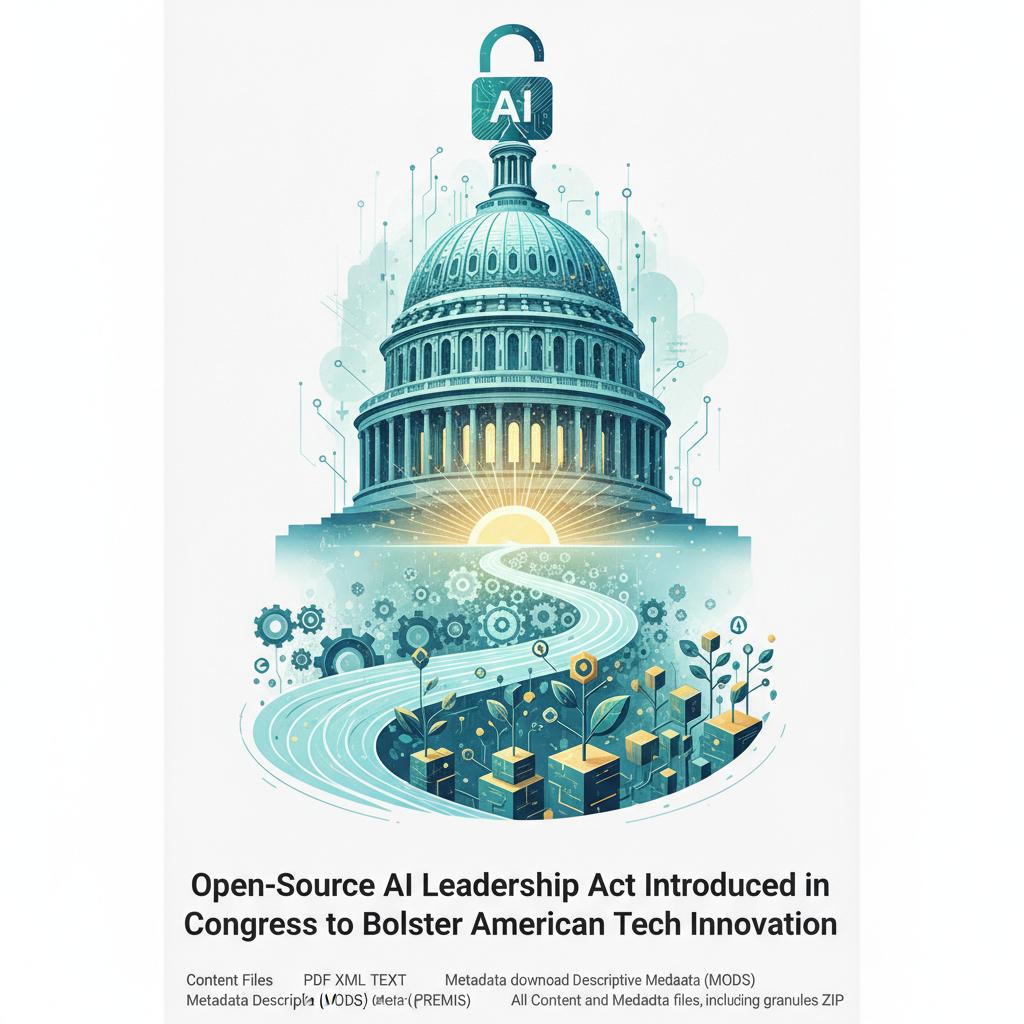
Open-Source AI Leadership Act Introduced in Congress to Bolster American Tech Innovation
Content Files PDF XML TEXT Metadata download Descriptive Metadata (MODS) Preservation Metadata (PREMIS) All Content and Metadata files, including granules ZIP

Last updated:
Key points
Open-Source AI Leadership Act Introduced in
- H.R. 10152, the Open-Source AI Leadership Act, has been formally introduced in the U.S. House of Representatives to support decentralized artificial intelligence development.
- The legislation aims to maintain American leadership in technology while preventing regulatory capture by dominant corporate tech incumbents.
- The measure addresses critical questions surrounding global competitiveness, economic opportunity for small businesses, and national security in emerging software sectors.
NewsWK — Lawmakers on Capitol Hill have formally introduced the Open-Source AI Leadership Act, designated as H.R. 10152, marking a significant legislative push to strengthen the United States’ competitive edge in the rapidly evolving artificial intelligence sector. The newly introduced measure seeks to foster transparent, publicly accessible artificial intelligence models, aiming to balance technological advancement, economic freedom, and national security.
As artificial intelligence continues to reshape industries across the United States, federal lawmakers are grappling with how best to regulate emerging technologies without suffocating domestic innovation. The introduction of H.R. 10152 signals growing congressional interest in preserving open-source software architectures, which allow independent researchers, entrepreneurs, and smaller enterprises to inspect, modify, and build upon existing foundation models rather than relying exclusively on proprietary systems controlled by tech conglomerates.
Why it matters here
For small businesses, software developers, and research institutions across the country, access to open-source artificial intelligence tools is increasingly viewed as an essential driver of economic opportunity. Unlike closed, centralized systems maintained by a handful of dominant tech corporations, open-source platforms provide local enterprises with cost-effective alternatives to integrate automated tools, data processing, and machine learning into their daily operations.
Proponents of open-source technology argue that keeping foundational code accessible prevents regulatory capture—a scenario where burdensome federal mandates disproportionately protect well-funded incumbents while locking out smaller competitors. For local economies and independent job creators, accessible AI tools mean lower barrier to entry, increased productivity, and the ability to customize software solutions to meet specific regional industry needs, from agriculture and manufacturing to logistics and community healthcare.
Balancing Innovation and National Security
The legislative effort arrives amid an ongoing debate in Washington regarding how the nation should approach global technology competition, particularly against state-backed adversaries such as the Chinese Communist Party. While some national security officials and large corporate developers have raised concerns that open models could be misused by bad actors, free-market advocates and open-source proponents contend that technological dominance relies on rapid, decentralized innovation.
Advocates maintain that open-source ecosystems enhance transparency, enabling security analysts and independent programmers to identify vulnerabilities, fix bugs, and ensure robust safeguards faster than closed corporate environments. By encouraging domestic leadership in open-source development, lawmakers aim to ensure American technological standards remain the global benchmark rather than ceding software leadership to foreign competitors operating under state control.
Background and Congressional Context
Federal legislative activity surrounding artificial intelligence has accelerated dramatically over the past two sessions of Congress. Following executive actions and various regulatory frameworks proposed by administrative agencies, members of Congress have introduced dozens of targeted bills addressing data privacy, intellectual property rights, algorithmic accountability, and the economic impacts of automation.
The debate between proprietary “walled garden” AI architectures and open-weight models has become a focal point for policymakers. Major Silicon Valley firms have often advocated for licensing regimes and strict compliance mandates that require immense capital outlays. In contrast, free-enterprise policy experts have warned that heavy-handed bureaucratic rules risk chilling venture capital investment and pushing American tech talent overseas.
H.R. 10152 now heads to committee for initial review and debate. As the bill moves through the legislative process, lawmakers will evaluate how federal policies can encourage responsible technological development, protect intellectual property, and safeguard taxpayer interests while avoiding excessive government intervention in a dynamic marketplace.
This article was produced with the assistance of AI and reviewed by our editorial team.
Sources
Related: House Introduces ‘No Insider Trading on National Security Act’ to Target Official Profiteering
See a typo? Report it here.