Washington
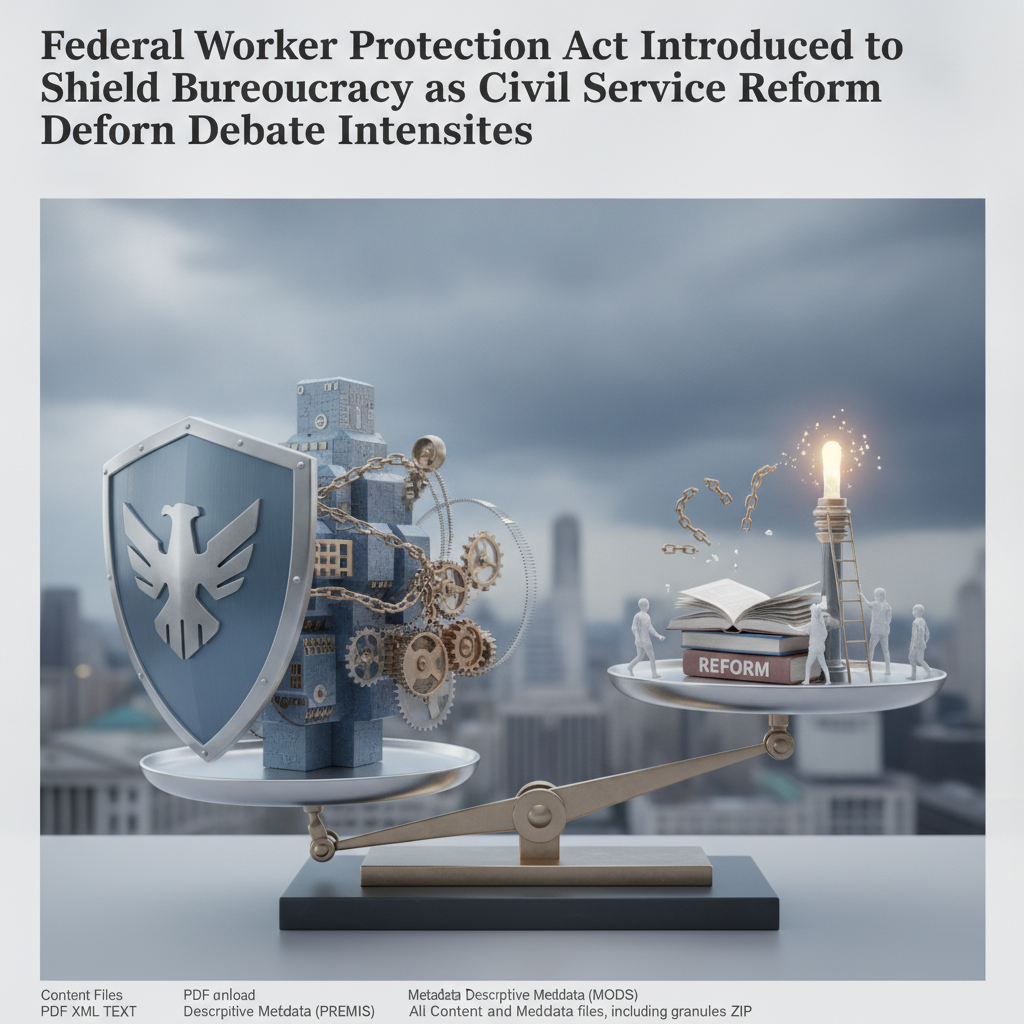
Federal Worker Protection Act Introduced to Shield Bureaucracy as Civil Service Reform Debate Intensifies
Content Files PDF XML TEXT Metadata download Descriptive Metadata (MODS) Preservation Metadata (PREMIS) All Content and Metadata files, including granules ZIP

Last updated:
Key points
- H.R. 10198, titled the Federal Worker Protection Act, has been introduced in the House of Representatives to strengthen job protections for federal civil service personnel.
- The legislation aims to prevent executive reclassification of career personnel and preserve statutory appeal rights across federal administrative agencies.
- The bill enters a broader debate over government accountability, balancing protections for career staff against the need for efficient agency management and responsiveness to elected leadership.
NewsWK — Lawmakers in the House of Representatives have formally introduced a new legislative measure aimed at reinforcing civil service job security across the federal government. Designated as H.R. 10198, the measure known as the Federal Worker Protection Act enters the legislative docket at a pivotal moment when the structure, accountability, and constitutional authority over the federal bureaucracy remain central topics of debate in Washington and across the nation.
The introduction of the measure reflects ongoing efforts by legislative sponsors to insulate career civil servants from sweeping executive reclassifications, political turnover, and streamlined disciplinary measures. As federal agencies oversee trillions of dollars in taxpayer funds and enforce broad administrative rules affecting commerce, energy, healthcare, and daily life, the rules governing how federal staff are hired, retained, and dismissed carry significant institutional consequences.
Why it matters here
For taxpayers, communities hosting regional federal offices, and families impacted by federal agency actions across the United States, civil service rules directly influence how efficiently and transparently the government operates. Millions of civilian federal employees work throughout the country, spanning defense logistics, agriculture inspection, land management, veterans’ care, and regulatory enforcement.
Proponents of heightened safeguards argue that strong civil service statutory protections ensure administrative continuity, protect technical expertise, and safeguard employees from partisan reprisal when carrying out their statutory duties. Conversely, proponents of civil service modernization and administrative accountability emphasize that overly rigid protections make it exceptionally difficult to discipline underperforming personnel, address bureaucratic inertia, or align agency staff with the policy directives of elected leadership.
Provisions and Debate Surrounding the Federal Worker Protection Act
The core framework of the federal worker protections bill focuses on limiting the ability of the executive branch to reclassify career nonpartisan positions into categories that lack standard administrative appeals and due process guarantees. In recent legislative cycles, debates have escalated regarding executive authority over civil service classifications, particularly mechanisms that would allow agency leadership to reassign or dismiss policy-influencing bureaucrats more swiftly.
Under current civil service frameworks rooted in the Civil Service Reform Act of 1978, nonpartisan career personnel enjoy procedural protections overseen by bodies such as the Merit Systems Protection Board (MSPB) and the Office of Special Counsel. H.R. 10198 seeks to reinforce these statutory walls, preventing future administrations from establishing alternative personnel classifications that bypass traditional merit system principles.
Accountability and the HR 10198 Federal Worker Protection Act
A key friction point in the discussion surrounding the HR 10198 Federal Worker Protection Act is the balance between merit protection and public accountability. Critics of expanding bureaucratic safeguards argue that career administrators must remain accountable to the president, who derives direct constitutional authority under Article II to execute federal law as an elected official accountable to voters.
From this perspective, excessive procedural hurdles can shield ineffective agency officials from standard performance management, driving up administrative overhead and weakening public trust in federal institutions. Reform advocates often point out that the private sector relies on robust accountability and merit-based management, arguing that government agencies should uphold similar standards of operational responsiveness to ensure taxpayer resources are handled responsibly.
Background on Federal Employees Legislation and Civil Service Reform
The modern civil service system was established over a century ago to replace the historical patronage system, establishing competitive examinations and objective standards for government employment. However, over subsequent decades, the growth of the administrative state has prompted recurring reviews of how best to manage federal workforce performance.
In recent years, legislative friction has intensified around executive branch directives, proposed civil service reclassifications, and union collective bargaining agreements within federal agencies. While certain lawmakers argue that career employees require absolute statutory insulation to prevent politicization, other reform-minded legislators advocate for streamlined removal processes, performance-based pay incentives, and enhanced oversight to curb administrative overreach.
As H.R. 10198 proceeds through the initial stages of the committee review process, its trajectory will depend heavily on broader congressional negotiations regarding workforce modernization, fiscal appropriations, and executive branch oversight. Lawmakers from both parties are expected to scrutinize the bill’s potential impact on agency effectiveness, federal labor relations, and the ongoing relationship between career personnel and elected policy leaders.
This article was produced with the assistance of AI and reviewed by our editorial team.
Sources
Related: Sanctuary Policies Block Federal Jail Transfers as ICE Ramps Up Enforcement Across U.S. Communities
Related: House Resolution Proposes Creation of Cabinet-Level ‘Department of Reconciliation’
Related: Protecting Americas Diplomatic Workforce Act: What to Know About HR 9728
See a typo? Report it here.