National News
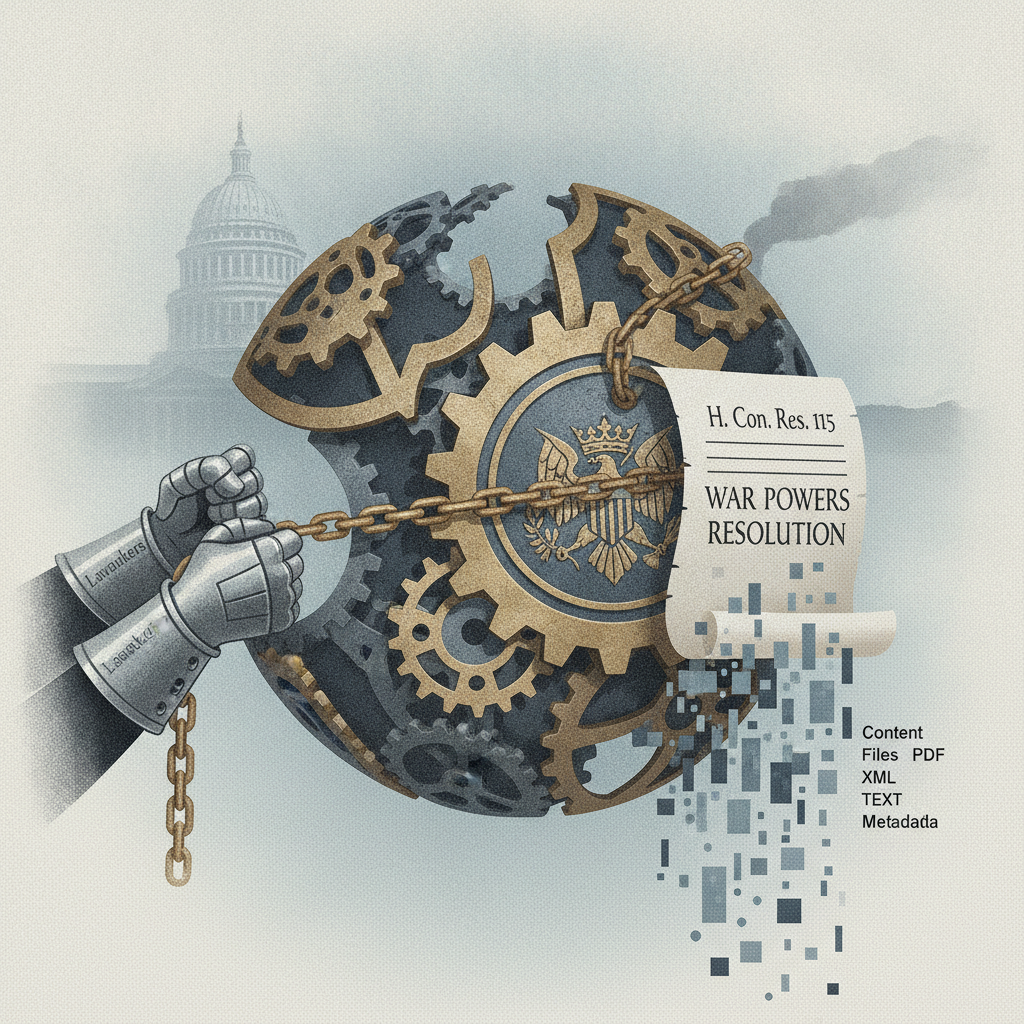
Lawmakers Challenge Executive Authority in H Con Res 115 War Powers Resolution
Content Files PDF XML TEXT Metadata download Descriptive Metadata (MODS) Preservation Metadata (PREMIS) All Content and Metadata files, including granules ZIP

Last updated:
Key points
- House Concurrent Resolution 115 invokes the War Powers Resolution to direct the removal of U.S. forces from unauthorized hostilities in the Western Hemisphere.
- The measure relies on Section 5(c) of the 1973 statute to enforce congressional war powers over executive branch military action.
- The resolution targets operations against presidentially designated terrorist organizations across the Americas.
NewsWK — Lawmakers on Capitol Hill are moving to reassert congressional control over foreign military entanglements. A newly filed measure challenges the executive branch over deployments across the Americas. House Concurrent Resolution 115 directly invokes federal statute to restrict unauthorized military combat. The legislation focuses specifically on operations against designated foreign groups throughout the region.
Why it matters here
Constitutional governance relies on strict limits on executive war powers. Everyday citizens across the country bear the financial and human costs when military forces deploy abroad. Therefore, debates over foreign deployments directly impact military service members, veteran families, and federal spending priorities.
Taxpayers also fund extensive national defense budgets every year. Many Americans demand greater transparency regarding where troops operate and why. Moreover, clear legal boundaries protect the nation from open-ended regional commitments without open public debate. When Congress asserts its constitutional responsibilities, local communities gain greater oversight over their loved ones in uniform.
What is House Concurrent Resolution 115 seeking to accomplish?
House Concurrent Resolution 115 directs the commander-in-chief to withdraw American troops from active hostilities involving designated terrorist organizations in the Western Hemisphere. The proposal relies on statutory authorities established under the War Powers Resolution of 1973. It requires an explicit mandate from Congress before troops engage in sustained combat abroad.
Federal records show the resolution specifically targets operations against presidentially designated terrorist groups. In recent years, discussions surrounding cross-border threats and regional cartels have intensified. Some defense planners have weighed unilateral operations against regional cartels. However, this measure draws a firm constitutional line. It insists that military action requires prior legislative approval.
Under federal law, concurrent resolutions provide Congress with a procedural tool to demand troop withdrawals. The measure points directly to Section 5(c) of the 1973 statute. That provision allows lawmakers to direct the removal of forces if Congress has not declared war.
How does the measure address US military action Western Hemisphere Congress debates?
The resolution forces an overdue debate on US military action Western Hemisphere Congress members have weighed for years. Lawmakers must decide whether counter-terror authorities apply broadly across Latin America and the Caribbean. Without an explicit declaration of war, the bill insists that unauthorized armed engagements must end immediately.
Several key provisions define the scope of this legislative effort:
- It invokes Section 5(c) of the War Powers Resolution to compel executive action.
- It targets hostilities involving presidentially designated terrorist groups in neighboring regions.
- It reinforces legislative oversight over counter-narcotics and counter-terror operations.
- It limits protracted executive deployments conducted without statutory authorization.
Meanwhile, national security analysts emphasize that border security and regional stability remain urgent priorities. Conservative lawmakers often champion strong borders and decisive defense. Yet constitutional conservatives also emphasize Article I authority. The Constitution vests the power to declare war squarely with the legislative branch, not the Oval Office.
Why are lawmakers invoking the War Powers Resolution Western Hemisphere rules now?
Lawmakers are turning to the War Powers Resolution Western Hemisphere mechanisms to prevent sudden military escalations without congressional consent. Rising concerns over regional security threats have prompted discussions about targeted strikes abroad. Consequently, sponsors of the measure want to establish clear guardrails before unauthorized conflicts expand into long-term entanglements.
Historical precedent plays a major role in this legislative push. In 1973, Congress passed the War Powers Resolution over a presidential veto. The statute established strict reporting requirements for foreign troop commitments. Furthermore, it created mechanisms to mandate troop withdrawals within specific time limits.
Next, the resolution must navigate the committee review process in the House of Representatives. Typically, such measures go before the House Committee on Foreign Affairs. Committee members examine the constitutional merits and operational consequences of the text. Still, legislative hurdles remain substantial before any concurrent resolution reaches the House floor for a final vote.
Supporters argue that open floor votes protect the constitutional balance of power. Lawmakers must go on the record regarding military operations close to American shores. But critics warn that rigid statutory limits could constrain rapid responses to immediate threats. As Congress debates the resolution, the core question remains centered on constitutional governance, executive restraint, and the ultimate authority to wage war.
This article was produced with the assistance of AI and reviewed by our editorial team.
Sources
Related: Congress Receives New Legislation Aimed at Local Health Care Protection
Related: ‘Not In My Barn Yard Act’ Introduced in Congress as Lawmakers Weigh Rural Property Protections
Related: Congress Considers War Powers Resolution Houthis Yemen Legislation
See a typo? Report it here.