Illinois
Federal Action Stops Invasive Tropilaelaps Mites Newark NJ Bound Cargo Ship Carried
How Long Can Mites Survive Without Their Honey Bee Hosts?


Last updated:
Key points
- Federal authorities intercepted an Asian giant honey bee swarm carrying invasive Tropilaelaps mercedesae and Kuzinia morsei mites on a cargo ship bound for Newark, New Jersey.
- Ship crew members destroyed the swarm at sea by freezing it under guidance from the U.S. Coast Guard and USDA-APHIS.
- A joint USDA study revealed the parasitic mites survived without bee brood for up to 99 days, far exceeding previous six-day estimates.
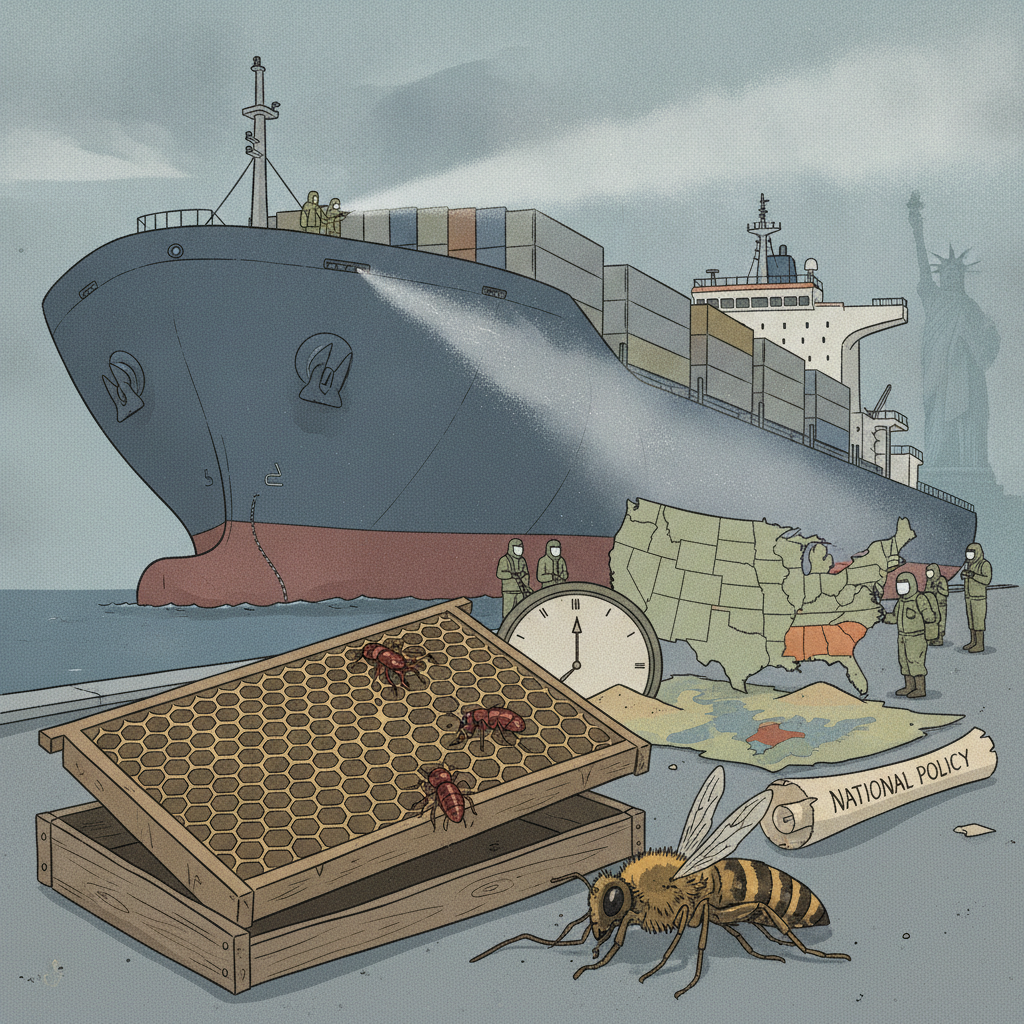
NewsWK — Federal officials recently intercepted an invasive pest threat heading directly toward American shores. In July 2025, maritime authorities spotted a swarm of Asian giant honey bees on a cargo vessel. The ship was inbound to Newark, New Jersey. Furthermore, the foreign insects carried dangerous parasitic mites that threaten domestic agriculture. Guided by federal protocols, the ship crew quickly destroyed the entire swarm at sea by freezing it. Consequently, this decisive action stopped the destructive pests from entering the United States.
What Happened During the Newark NJ Honey Bee Mite Interception?
Federal inspectors and maritime crews coordinated swiftly to isolate a major biosecurity hazard on the Atlantic Ocean. The intercepted swarm contained Asian giant honey bees, known as Apis dorsata. In addition, crew members found two parasitic mite species within the colony: Tropilaelaps mercedesae and Kuzinia morsei. Notably, this marked the first recorded U.S. interception of Kuzinia morsei.
The container ship carried commercial cargo directly toward northern New Jersey. However, emergency protocols kept the vessel from spreading pests into domestic ports. Officials from the U.S. Coast Guard worked alongside the USDA Animal and Plant Health Inspection Service. Together, they instructed the maritime crew to freeze the bee colony immediately. As a result, this process successfully eradicated every mite before the vessel docked.
What Does the Newark Cargo Ship Bee Swarm Mean for American Agriculture?
Strict biosecurity measures at sea remain essential to protect American farms and food security. Invasive mites can inflict severe financial damage on commercial beekeepers and crop growers. Therefore, intercepting dangerous pests early protects both agricultural businesses and consumers.
Invasive parasites pose a direct threat to domestic honey bee colonies across North America. For instance, Tropilaelaps mites feed on the blood of developing bee larvae and pupae. Additionally, these mites spread multiple deadly viral infections among colonies. Specifically, these pathogens include:
- Deformed wing virus, which cripples adult flight capacity.
- Black queen cell virus, which destroys developing queen bees.
- Acute paralysis virus, which causes sudden hive die-offs.
- Sacbrood virus, which targets developing larvae.
If these pests enter domestic hives, control costs will surge for local farmers. Thus, strong enforcement of international shipping standards remains the first line of defense for American agriculture.
What Did the USDA Honey Bee Mite Study Discover?
A federal investigation showed that foreign mites endure long maritime voyages much better than previously recorded. Entomologists from the USDA Agricultural Research Service worked with inspection specialists to analyze the vessel’s journey. Ultimately, their published findings confirm that parasitic mites can survive extended ocean crossings without host breeding brood.
Researchers Jose Luis Ramirez, Allan H. Smith-Pardo, and Ron Ochoa authored the report. They published their findings in the journal Frontiers in Insect Science. Dr. Ramirez works at the Crop Bioprotection Research Unit in Peoria, Illinois. During the investigation, their team examined shipping logs to determine how long the pests survived at sea. Previously, scientists believed Tropilaelaps mites died after six days without immature bee larvae. However, molecular tests and vessel tracking proved that assumption wrong.
How Does Extended Tropilaelaps mercedesae Survival Impact Cargo Shipping Oversight?
Revised scientific timelines prove that foreign pests can survive month-long ocean voyages aboard commercial vessels. Specifically, genetic testing confirmed that the intercepted swarm originated on the Indian subcontinent. Depending on where the bees boarded, the mites survived without bee brood for 29 to 99 days. Furthermore, the vessel spent 16 continuous days at sea without opportunities for external foraging.
Alternative shipping routes showed similar survival spans. For example, if the bees boarded in Karachi, Pakistan, the mites survived for 20 to 28 days. Even on a shorter route from Salalah, Oman, the pests endured 16 to 18 days without reproductive brood. Consequently, federal researchers concluded that these parasites present a much higher risk for long-distance transport than previously documented.
Scientists are now evaluating how these mites survive so long. They may feed directly on adult giant honey bees or simply tolerate prolonged starvation. Meanwhile, federal inspectors continue to monitor incoming international vessels closely. Overall, early maritime detection protects American agriculture and safeguards the nation’s vital food infrastructure.
This article was produced with the assistance of AI and reviewed by our editorial team.
Related: What a Newark New Jersey Streetlight Crime Study Reveals About Urban Safety
Related: Ukraine Strike Russian Ship Libya Operation Signals Expanding Mediterranean War