Massachusetts
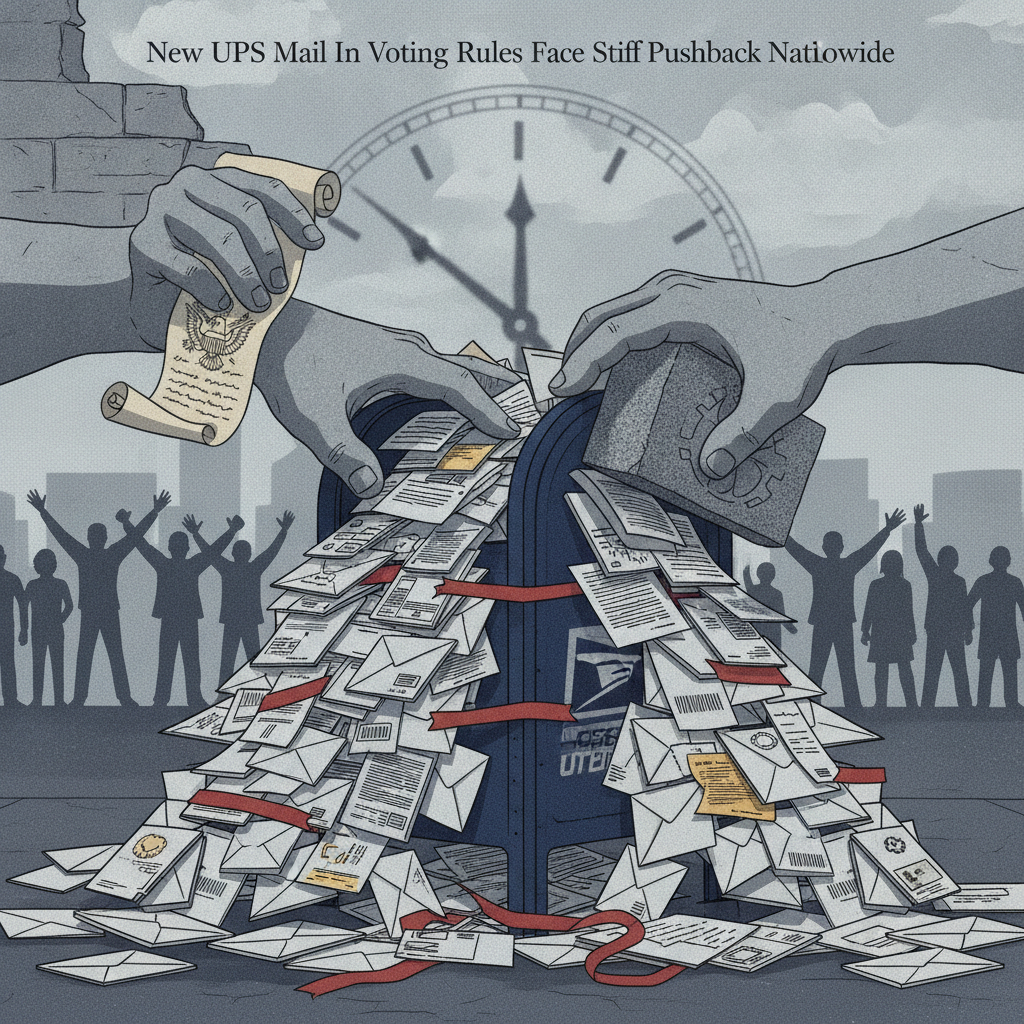
New USPS Mail In Voting Rules Face Stiff Pushback Nationwide
President Donald Trump’s executive order placing new restrictions on mail-in voting would assign state officials a Herculean task to reach compliance before the crucial midterm elections. The order directed the U.S. Postal Service to strictly regulate the envelope design of…

Last updated:
Key points
- A federal executive order directed the Postal Service to impose strict ballot envelope rules and collect voter file data through a new portal.
- Local and state election officials report that tight printing schedules and agency backlogs make pre-midterm compliance unworkable.
- A federal court paused the requirements through September 11 while multi-state lawsuits proceed.
NewsWK — Voters across America expect smooth logistics and dependable rules whenever election season arrives. A recent presidential directive has placed the postal system at the center of national debate. President Donald Trump signed a mail in voting executive order directing the U.S. Postal Service to overhaul ballot processing standards. Consequently, state officials and local election administrators face a difficult race against the calendar.
Why it matters here
Dependable elections protect civic trust, constitutional order, and municipal budgets across the nation. Abrupt federal mandates place immediate financial strain on local taxpayers. For instance, towns must pay for emergency printing runs and sudden software modifications. Meanwhile, local election workers need predictable guidelines to verify each lawful ballot accurately.
What are the new Postal Service ballot regulations?
The new Postal Service ballot regulations require states to standardize envelope dimensions before mailing. Furthermore, local election offices must secure federal design approval and upload voter data to an online federal portal. The Postal Service insists these measures enforce technical mail specifications. However, critics argue the policy disrupts established voting procedures.
Agency officials maintain that the policy falls within their regulatory authority over mail classes. But state election administrators view the directive quite differently. They contend that the mandates dictate election administration. Crucially, the U.S. Constitution reserves that authority primarily for the states.
Under the new framework, states must complete several complex assignments:
- Redesign all absentee envelopes to meet rigid federal barcode and size specifications.
- Secure formal verification from Postal Service technical analysts before distributing materials.
- Procure millions of newly designed envelopes from specialized commercial printing vendors.
- Transmit state voter lists into a newly developed postal information portal.
- Instruct municipal staff and voters on the updated envelope protocols.
How do mail in ballot envelope requirements impact local clerks?
Strict envelope requirements demand long lead times that local election clerks simply do not have. Commercial print shops typically require twelve to sixteen weeks to manufacture customized ballot envelopes. Furthermore, only about 40 mail design analysts nationwide review thousands of jurisdictions. Therefore, election administrators anticipate massive processing bottlenecks that could delay distribution.
As a result, election workers fear that a severe bottleneck will stall autumn mailings. For example, North Carolina planned to send out absentee ballots this week. Many states already finalized and printed their November inventory during the summer months. Katy Owens Hubler, elections director at the National Conference of State Legislatures, highlighted this practical barrier. “In general, you don’t want to be changing things right before the election,” Hubler said.
Eight states currently conduct elections entirely by universal mail:
- California
- Colorado
- Hawaii
- Nevada
- Oregon
- Utah
- Vermont
- Washington
Large universal-mail states often retain commercial contract printers. In contrast, smaller rural counties lack those robust resources. Therefore, smaller election offices face the greatest risk of logistical failure under sudden changes.
Can election offices meet the midterm election mail in voting deadline?
State leaders warn that meeting the midterm deadline under these rules is practically impossible. Most local jurisdictions have already committed their operating budgets, technical protocols, and seasonal staffing. Consequently, requiring an operational overhaul weeks before voting starts threatens to disrupt standard ballot delivery. Local clerks cannot implement such massive revisions on short notice.
Tammy Patrick, chief programs officer at the National Association of Election Officials, summarized the scheduling conflict in a court declaration. “None of the Rule’s requirements can feasibly be implemented before the November 3, 2026, General Election,” Patrick stated. In addition, she noted that local offices operate on tight, unchangeable public budgets.
Furthermore, the federal digital database remains incomplete. Postal officials described the portal as part of an ongoing modernization initiative. But outside election analysts warn that testing and deploying complex voter-data tools takes months of careful preparation.
Why are federal courts intervening on USPS mail in voting rules?
Federal courts intervened because altering election procedures right before voting begins invites widespread administrative chaos. More than 20 Democratic-led states filed legal challenges to overturn the policy. In response, a federal judge in Massachusetts paused enforcement through September 11 while courts weigh constitutional arguments. This temporary halt gives election officials brief breathing room.
The legal dispute tests the boundary between federal agency authority and state election control. For its part, the Postal Service argues that uniform physical standards ensure reliable transit. In contrast, state officials argue that abrupt changes will cause rejected ballots and voter confusion. Thus, the court battle highlights deep divisions over voting administration.
Ultimately, election analysts expect judicial rulings to determine whether these federal standards take effect this year. Meanwhile, local clerks must continue preparing for the midterms under significant legal uncertainty. Transparent rules and reliable operations remain critical to preserving public confidence in the vote.
This article was produced with the assistance of AI and reviewed by our editorial team.
Sources
Related: Supreme Court Lifts Injunction on Federal Mail-In Ballot Security Standards Ahead of Midterms
Related: Democrats aim to emulate Republicans in building state power
See a typo? Report it here.