Washington
Federal House Resolution Proposes Official Recognition for 2026 Pride Month
Content Files PDF XML TEXT Metadata download Descriptive Metadata (MODS) Preservation Metadata (PREMIS) All Content and Metadata files, including granules ZIP

Last updated:
Key points
Federal House Resolution Proposes Official
- House Resolution 1405 was introduced in the 119th Congress to recognize June 2026 as LGBTQIA+ Pride Month.
- As a simple resolution, the measure is non-binding and does not carry the force of federal law or appropriate federal funds.
- The proposal has been referred to committee for consideration amid broader debates over congressional legislative priorities.
NewsWK — A new resolution introduced in the United States House of Representatives seeks to officially designate June 2026 as LGBTQIA+ Pride Month, marking the latest iteration of commemorative legislation brought before federal lawmakers in the 119th Congress.
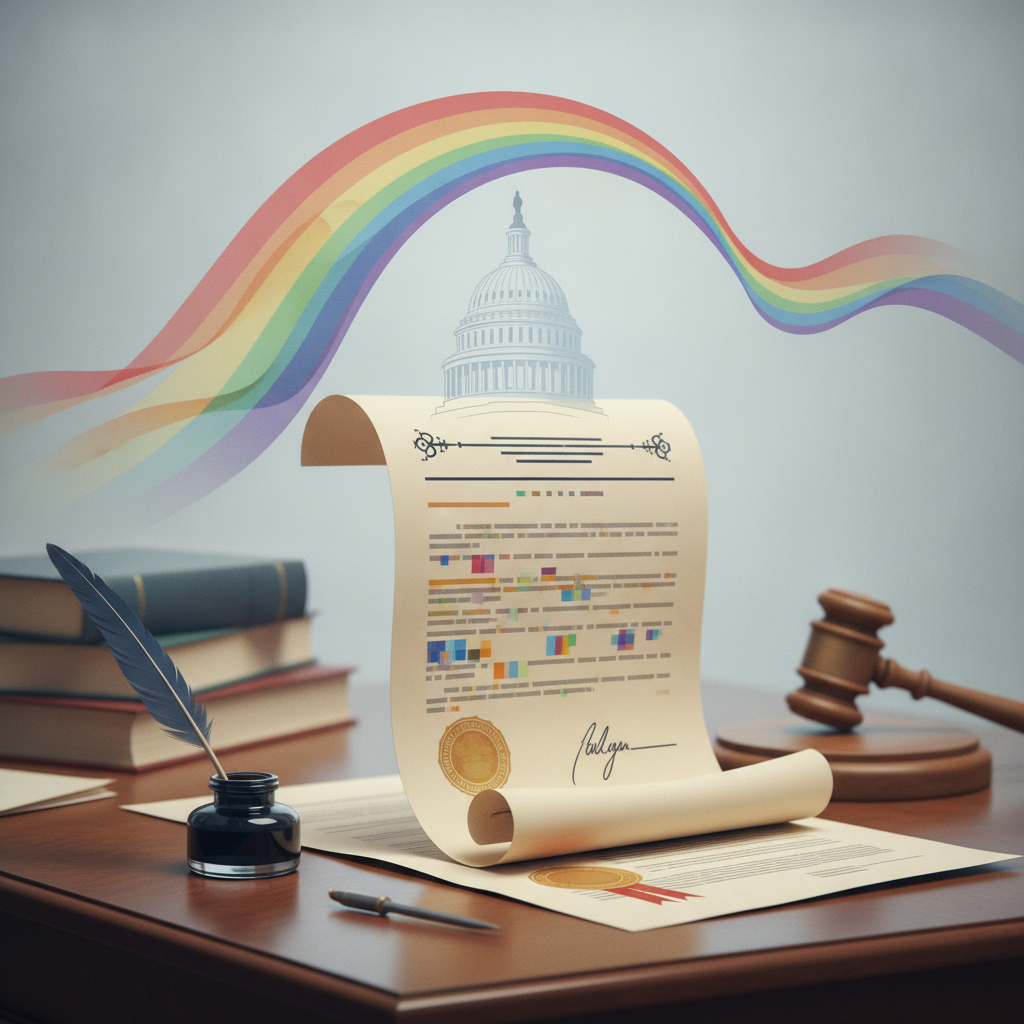
The measure, designated as House Resolution 1405 (H. Res. 1405), was formally introduced and submitted to federal legislative databases under the title “Original LGBTQIA+ Pride Month Resolution of 2026.” As a simple resolution originating in the House, the proposal represents an explicit expression of the sentiment of the chamber rather than a statutory mandate or binding law.
Why it matters here
For communities and taxpayers across the nation, federal legislative activity serves as a indicator of congressional priorities during a period marked by significant economic and regulatory challenges. Simple resolutions do not carry the force of federal law, do not require approval by the Senate, and are not submitted to the President for signature. Consequently, they do not create federal mandates, appropriate taxpayer dollars, or directly alter state and local governance.
However, the introduction of non-binding cultural resolutions frequently sparks discussion among local civic leaders, family advocacy groups, and constituents regarding the proper scope and focus of the federal legislature. Many residents express concern over the time and administrative effort dedicated to federal symbolic proclamations at a time when local communities are navigating fiscal pressures, rising energy and housing costs, infrastructure requirements, and public safety needs. Observers who favor a limited role for the federal government emphasize that Congress should prioritize statutory duties, such as federal budget appropriations, national defense authorization, and regulatory oversight, rather than formal recognition of selective social movements.
Conversely, supporters of commemorative resolutions argue that formal congressional recognition provides visibility and validation to specific advocacy groups, setting a standard that local municipalities and corporate entities often mirror in regional policies and public observances.
Legislative Scope and Background
Under established parliamentary procedure in the U.S. House of Representatives, resolutions designated with the suffix “IH” reflect the initial introduced version of a measure as submitted by its sponsor. Once introduced, the resolution is referred to the appropriate House committee for preliminary consideration, where lawmakers determine whether the proposal will advance to the full House floor for a vote.
Historically, congressional resolutions declaring commemorative months, weeks, or days have been a routine feature of Capitol Hill operations. While early historical resolutions primarily focused on honoring military service, national defense milestones, or foundational constitutional events, recent decades have seen a significant expansion in the variety and subject matter of recognition measures proposed by members of Congress.
The introduction of H. Res. 1405 highlights an ongoing national dialogue regarding neutral governance and civic unity. Critics of federally sponsored identity-based recognitions contend that governmental bodies should maintain strict neutrality, focusing strictly on equal protection under the law and universal constitutional rights rather than highlighting specific political or social categories. Supporters maintain that congressional resolutions offer an important venue for legislative expression and social advocacy.
As the 119th Congress continues its legislative agenda, H. Res. 1405 remains subject to committee review. Whether House leadership elects to allocate floor time for debate or consideration of the measure will depend on committee proceedings and broader legislative scheduling decisions in Washington.
This article was produced with the assistance of AI and reviewed by our editorial team.