District of Columbia
Federal Judge Rejects Democratic Challenge to Upcoming Medicaid Work Requirements
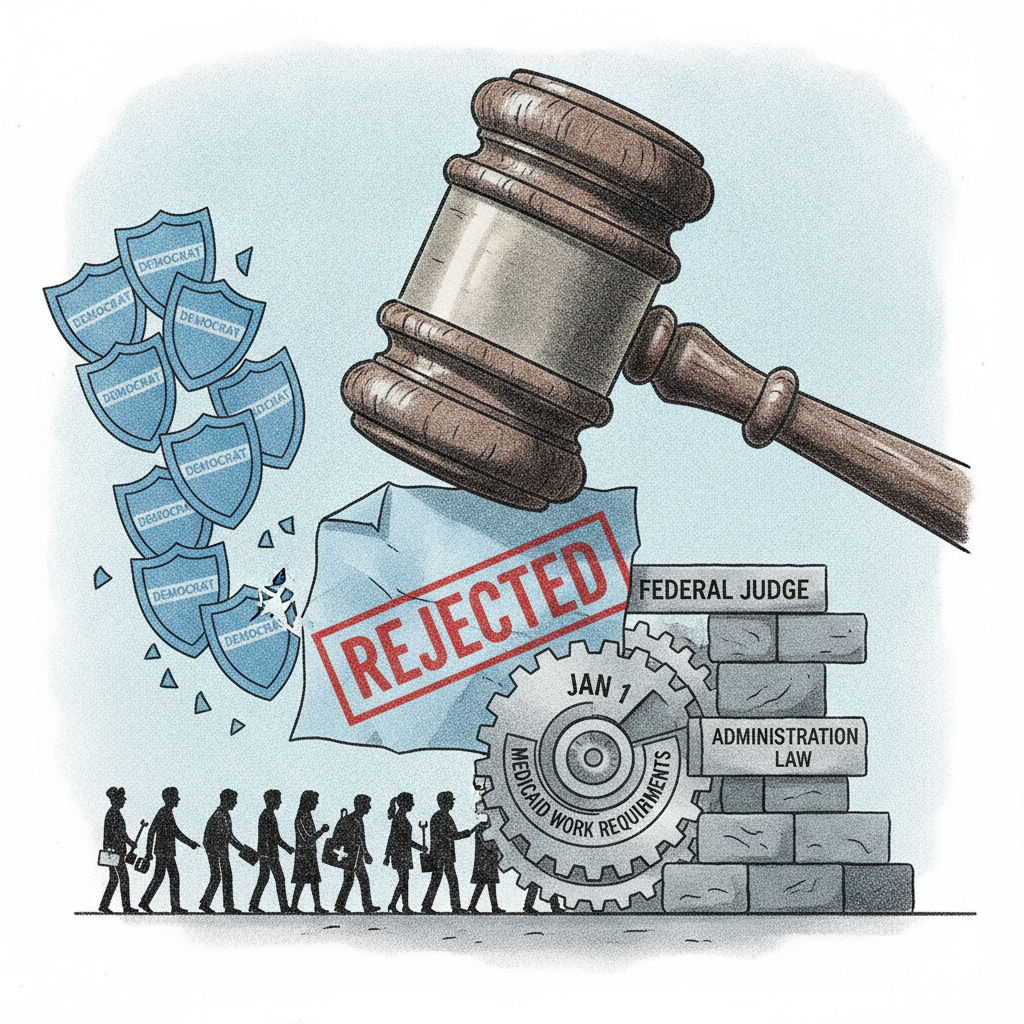
States will have to meet a Jan. 1 deadline to implement new Medicaid work requirements, after a federal judge denied 25 Democratic-led states’ request to pause implementation of the rule. The broad tax and spending law President Donald Trump signed…

Last updated:
Key points
Federal Judge Rejects Democratic Challenge to
- A federal judge denied a legal bid by 25 states to halt new Medicaid work rules ahead of the Jan. 1 deadline.
- The federal policy requires able-bodied Medicaid expansion recipients to work, volunteer, or attend school for 80 hours monthly.
- The federal government is covering 90% of the administrative costs states incur to set up and run the work requirement program.
NewsWK — According to a report first published by Stateline, a federal court has denied a request by 25 Democratic-led states to halt new federal Medicaid work requirements scheduled to take effect on Jan. 1.
Court Upholds Medicaid Work Requirements for Able-Bodied Adults
The work rules, enacted under federal legislation signed by President Donald Trump last summer, require able-bodied adults enrolled in Medicaid expansion programs to complete at least 80 hours per month of employment, job training, education, or volunteer service to maintain their healthcare benefits. The mandate applies across 42 states and the District of Columbia that expanded Medicaid under the Affordable Care Act.
States Challenge Rules on Medicaid Work Requirements
Democratic attorneys general and governors filed suit in late June against the U.S. Department of Health and Human Services and the Centers for Medicare and Medicaid Services (CMS). The lawsuit targeted federal guidance that narrowed the definition of “medically frail” individuals who are exempt from the work requirements due to serious health conditions. Plaintiffs argued the updated definition was overly restrictive and created burdensome administrative costs for state agencies.
Federal Funding Offsets State Costs
In denying the preliminary injunction, U.S. District Judge Richard Stearns noted that the federal government will reimburse state agencies for 90% of the costs required to design and implement the system, leaving states responsible for the remaining 10%.
Judge Stearns ruled that the states failed to demonstrate irreparable financial harm necessary to justify stopping a law enacted by Congress.
“Because injunctive relief is the exception, not the rule, there is a certain point at which damages fail to justify the issuance of such an extraordinary measure,” Stearns wrote. “Plaintiffs have not shown that their damages rise above that minimal threshold here.”
The court also emphasized that the Jan. 1 compliance deadline was established directly by Congress, and that state administrators already possess the operational infrastructure required to implement the rules without disproportionate cost overruns.
Based on reporting by Nada Hassanein originally published by Stateline. Read the original story.
Federal Judge Rejects Democratic Challenge to coverage on NewsWK includes background, context, and related reporting for readers following this story.
NewsWK publishes local and national news with clear headlines, source context, and follow-up when developments change. This article is part of ongoing coverage intended to help readers stay informed.
For more on Federal Judge Rejects Democratic Challenge to, browse related NewsWK stories and check back for updates as new information becomes available.
Our editors review developing stories and update articles when material facts change, so readers can rely on NewsWK for clear, timely reporting.
Related: Medical Groups and Cities File Medicaid Work Requirements Lawsuit to Challenge New Federal Rules
Related: House Resolution 1499 Clears Way for Critical Votes on Mining, Higher Education, and Maritime Rules
Related: Study Examines Women on Parole Mental Health and Reentry Crises Across the US
See a typo? Report it here.