
California
San Francisco AI Boom Fuels Growth but Escalates Tech Market Crash Fears
San Francisco is enjoying an AI boom, but worries about a crash are growing ‘No dates with AI workers’: Silicon Valley’s new dating dealbreaker San Francisco’s AI boom meets a market selloff as crash worries grow San Francisco Builds AI…


Last updated:
Key points
- San Francisco secured 60 percent of all United States venture capital invested in artificial intelligence from 2023 to 2025.
- Despite the massive capital investment, San Francisco remains 35,000 jobs short of its pre-pandemic peak.
- Recent stock market volatility and high corporate valuations have sparked fears of a potential correction across the Bay Area.
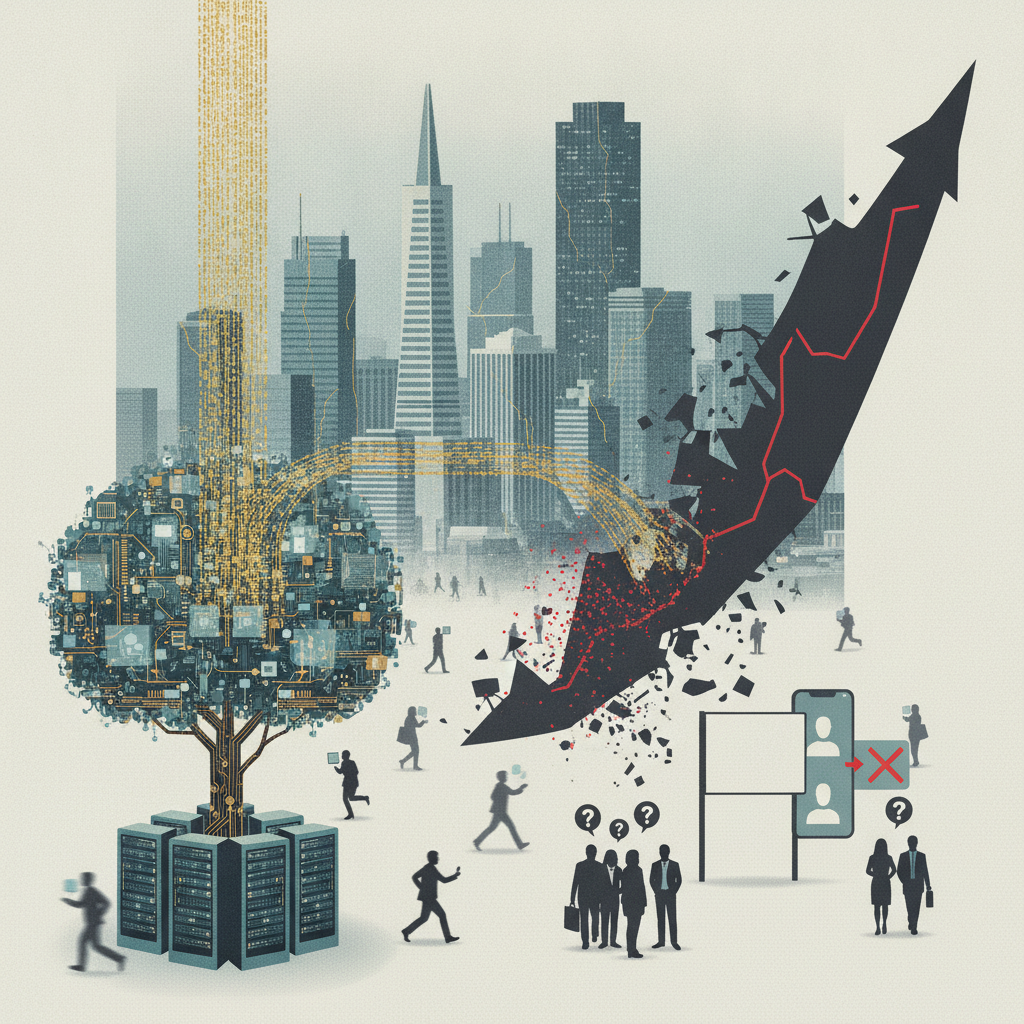
NewsWK — Billion-dollar investments and rapid corporate expansions are transforming Northern California‘s commercial landscape. Between 2023 and 2025, venture capital firms funneled huge sums into local enterprises. Specifically, these businesses captured about 60 percent of all United States artificial intelligence funding. However, underlying market volatility and stalled payroll figures still concern fiscal analysts and local residents.
Why are San Francisco tech market crash fears growing despite heavy investment?
San Francisco tech market crash fears are rising. Massive capital inflows have failed to generate widespread job growth across Northern California. Analysts note that high corporate valuations contrast sharply with sluggish hiring trends. Furthermore, international financial institutions warn that overextended artificial intelligence valuations could trigger a sharp regional financial correction.
City employment figures highlight a stark contrast between corporate capital and overall San Francisco tech jobs. For example, San Francisco remains 35,000 positions short of its pre-pandemic employment peak. San Francisco Chief Economist Ted Egan noted that tech is thriving again. However, he added, “we are not seeing tonnes of overall tech job growth.”
Meanwhile, industry experts urge caution regarding sky-high corporate spending. In October 2026, the International Monetary Fund issued an official warning. It cited potential downward corrections in artificial intelligence share prices. Also, one local tech employee told reporters, “I am certain that the house of cards will come down… and I’m sure it will affect me.” Consequently, investors question whether firms can generate sufficient revenue. They doubt companies can support current spending commitments.
Which San Francisco AI companies are leading the local surge?
Leading San Francisco AI companies like OpenAI and Anthropic are driving the current technological wave. For instance, Anthropic completed its listing on the Nasdaq stock exchange in November 2026. Additionally, these major firms attract billions in private equity and anchor commercial real estate leases. They also dominate regional billboard advertising throughout downtown corridors.
These major institutions dominate the commercial real estate landscape in downtown quarters. Anthropic developed the Claude chatbot. The company listed on the Nasdaq during the third week of November 2026. Meanwhile, OpenAI continues to expand its local corporate footprint. Consequently, these market leaders attract huge capital pools. In turn, this influx drives up commercial property activity across the city center.
What does the AI surge mean for San Francisco small businesses?
The artificial intelligence expansion provides immediate economic revenue for specialized local service providers. Across the metropolitan area, rising engineering salaries and corporate spending boost local demand. Specifically, tech workers seek out high-end amenities, pet services, and retail. However, escalating housing costs and higher office rents pressure traditional small business owners.
The influx of venture capital has generated positive spillovers for small local vendors. For example, service companies are expanding operations to meet tech workers’ demands. Lauren Goldboss owns a local dog-walking business. Recently, she launched a dedicated service named “Paw Perk” for start-up offices. To meet rising demand, she bought new vans and hired additional staff members.
However, the local real estate market presents ongoing challenges for ordinary residents. First, Higher Engineering Salaries Drive up residential rents and single-family home prices across nearby neighborhoods. In addition,
Here are key economic indicators shaping the local business environment:
- Venture capital concentration: San Francisco firms secured 60 percent of national artificial intelligence funding between 2023 and 2025.
- Employment gap: The municipal workforce remains 35,000 jobs below pre-pandemic levels.
- Market correction impact: The S&P 500 index dropped 10 percent into correction territory during late November 2026.
- Valuation swings: Nvidia shares fell 7.3 percent to $135.34 on November 20, 2026. That drop erased $260 billion in market value.
How does the current market volatility affect the broader San Francisco tech economy?
Recent market swings highlight the vulnerability of the San Francisco tech economy. Broader valuation shifts directly impact the region. For instance, and regional employment stability.
Recent financial reports underscore the fragile state of tech market valuations. On November 18, 2026, chip maker Nvidia reported its quarterly profits. Those profits doubled year-over-year to $65 billion. However, leadership controversies involving former chief executive Jensen Huang unsettled investors. On November 20, 2026, Nvidia stock dropped 7.3 percent to $135.34. Consequently, the plunge wiped out $260 billion in market capitalization.
Meanwhile, economic researchers warn of broader ripple effects. UC Berkeley economics professor Enrico Moretti issued a stark warning. He noted a market correction could prove very painful for service jobs and office space. Similarly, Jeff Bellisario of the Bay Area Council Economic Institute weighed in. He stated that overall hiring falls short of typical venture capital expansion cycles.
How is the technology surge changing Silicon Valley culture?
The financial surge is reshaping social interactions and dating dynamics across the Bay Area community. Today, tech employment status and corporate philosophy heavily influence personal relationships. Furthermore, many residents express concerns over job automation. Consequently, this anxiety leads to distinct social divisions between software engineers and non-tech workers.
Cultural changes are becoming evident across social platforms and daily interactions. For example, singles on dating applications like Hinge are changing their preferences. Many report filtering out employees from major automation firms. Furthermore, prospective partners often view roles at companies like OpenAI or Palantir as red flags. Conversely, some tech founders use software tools and spreadsheets to organize personal dates. At the same time, they refuse to date critics of technological progress.
This article was produced with the assistance of AI and reviewed by our editorial team.
Sources
Related: Study Examines Women on Parole Mental Health and Reentry Crises Across the US
Related: House Resolution 1499 Clears Way for Critical Votes on Mining, Higher Education, and Maritime Rules


