Ohio
House Bill HR 10914 Proposes Reauthorization for the Farming Opportunities Training and Outreach Grant Program Through 2031
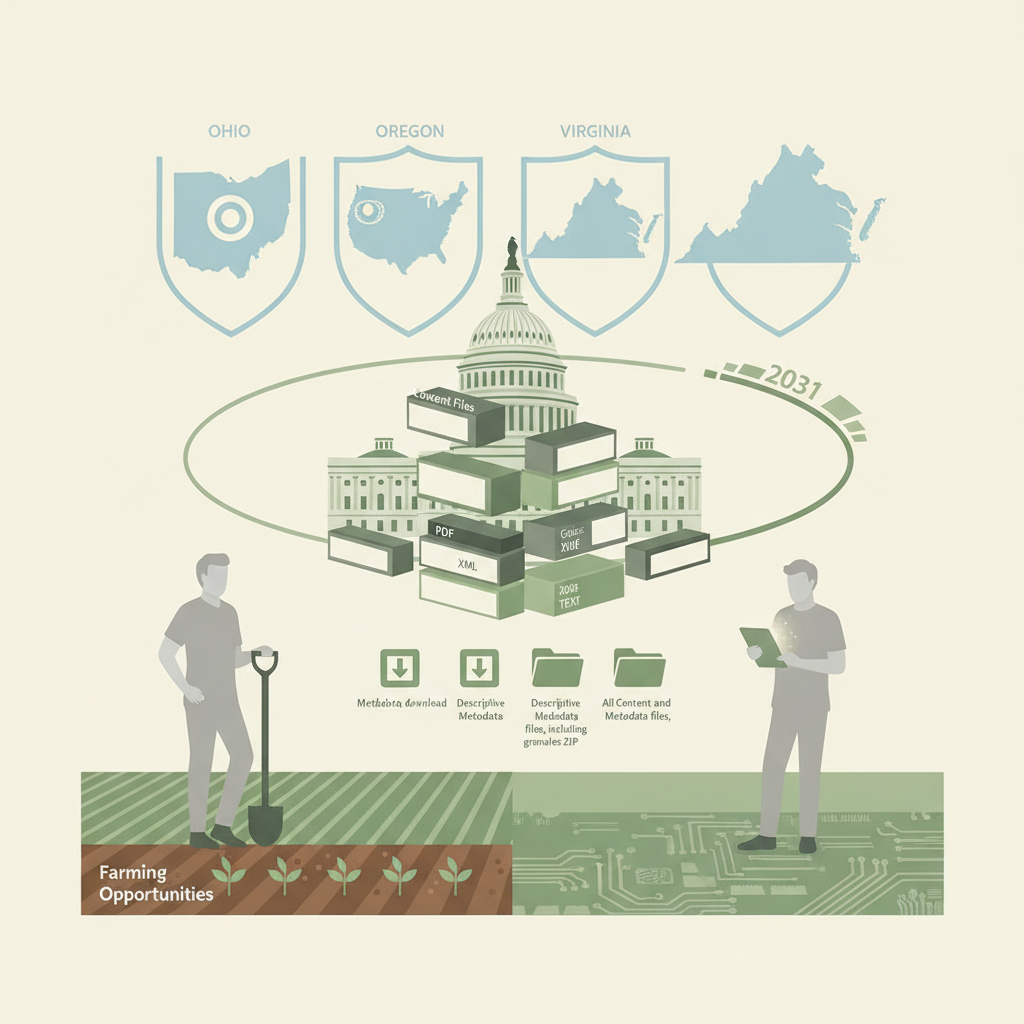
Content Files PDF XML TEXT Metadata download Descriptive Metadata (MODS) Preservation Metadata (PREMIS) All Content and Metadata files, including granules ZIP

Last updated:
Key points
- Representative Jennifer L. McClellan introduced HR 10914 to reauthorize the Farming Opportunities Training and Outreach Grant Program through fiscal year 2031.
- The bill prioritizes technical assistance, translation services, and grant opportunities for military veterans, beginning farmers, and underserved agricultural producers.
- New transparency provisions require the USDA to publish disaggregated data on farm resource holdings, loan participation, and payment yields every five years.
NewsWK — Lawmakers in Washington have introduced new legislation to reauthorize a major federal agricultural outreach effort. Representative Jennifer L. McClellan of Virginia introduced HR 10914 in the House of Representatives on October 26, 2026. Representative Andrea Salinas of Oregon and Representative Shontel M. Brown of Ohio joined as initial cosponsors. The measure renews and updates the statutory framework for education, training, and technical assistance. Consequently, it supports independent agricultural operators across the United States.
What does HR 10914 change for underserved farmers assistance programs?
HR 10914 extends funding authorization for federal farm assistance initiatives through fiscal year 2031. Furthermore, the bill expands language translation options and updates numerical grant guidelines. It also establishes stricter reporting mandates for the United States Department of Agriculture. These changes enhance accessibility for targeted agricultural groups and track participation metrics across federal programs.
The proposed law updates Section 2279 of Title 7 in the United States Code. That statutory baseline originates from the Food, Agriculture, Conservation, and Trade Act of 1990. Previous authorization expired at the end of fiscal year 2023. Therefore, the current bill fills a regulatory gap. Specifically, the bill permits grant recipients to offer language interpretation services to non-English speakers. As a result, entities that provide these translation tools will receive priority consideration during grant evaluations. In addition, the legislation modifies grant collaboration thresholds from three to four entities. This change allows larger regional partnerships among agricultural organizations.
How do USDA farmer training grants support military veterans and new growers?
Under the statutory framework, USDA farmer training grants deliver critical educational resources and financial guidance. Participating groups also provide hands-on technical support to beginning growers and military veterans. Organizations receive awards capped at $250,000 per year for up to three years. Consequently, these funds help qualified recipients establish viable farming enterprises and navigate federal agricultural loan programs.
Federal law defines a beginning producer as an individual with ten years or fewer of operating experience. Meanwhile, veteran farmer grants target former military service members who wish to transition into agricultural production. Community-based non-profits, state agencies, and land-grant universities apply for these competitive funds. However, grant recipients must generally provide a 25 percent matching contribution from non-federal sources. Federal officials can reduce or waive that matching requirement. Specifically, this waiver applies to organizations operating in severely economically distressed rural areas.
What does this legislation mean for American agricultural producers?
For producers across the country, the bill secures structured educational programs and direct community support. These localized services also help growers maintain profitable operations in competitive regional markets.
Local agricultural economies rely heavily on succession planning and stable land management. For example, many retiring farmers seek qualified successors to keep working land in active production. Through localized workshops and technical training, participating groups teach financial management and crop planning. Moreover, these programs assist military veterans in applying civilian management skills. Veterans use these skills for row crops, livestock, and specialized produce operations. Taxpayers also benefit when government programs incorporate clear accountability standards and measurable economic results.
What transparency requirements will the USDA face under HR 10914?
The legislation establishes new statistical reporting guidelines for the Secretary of Agriculture to track program outcomes. By March 31, 2028, the USDA must publish detailed data on farm resource holdings. This data includes base acres, yield history, and loan involvement. Thereafter, the agency must update these datasets every five years alongside annual federal participation reports.
Congress designed these reporting mandates to increase transparency regarding federal farm safety nets. Consequently, the dataset must analyze participation metrics across race, ethnicity, and gender categories. Lawmakers will use this oversight data to evaluate federal farm safety nets. Specifically, they will check whether these programs reach all eligible agricultural producers fairly. Furthermore, accurate data collection helps prevent administrative waste. It also ensures that taxpayer funds achieve their intended legislative goals.
What is the legislative status of the Farming Opportunities Training and Outreach Grant Program?
Following its formal introduction, House leadership referred HR 10914 to the House Committee on Agriculture for initial review. The bill must undergo committee hearings, potential amendments, and full committee approval. Afterward, it can advance to the House floor. Meanwhile, agricultural stakeholders and fiscal policy analysts continue to monitor the bill’s legislative trajectory in Congress.
The House Committee on Agriculture maintains jurisdiction over federal farm policy, conservation initiatives, and agricultural grant administration. Therefore, committee members will evaluate the bill’s budget impact before scheduling a formal markup session. If Congress approves the measure, it will proceed to the President for final signature.
This article was produced with the assistance of AI and reviewed by our editorial team.
Sources
Related: House Lawmakers Introduce Opening Programs to Organic Farms Act to Address Agricultural Access
Related: Voice for Farm Workers Act Introduced in U.S. Senate as Lawmakers Debate Agricultural Labor Policy
See a typo? Report it here.