
Washington
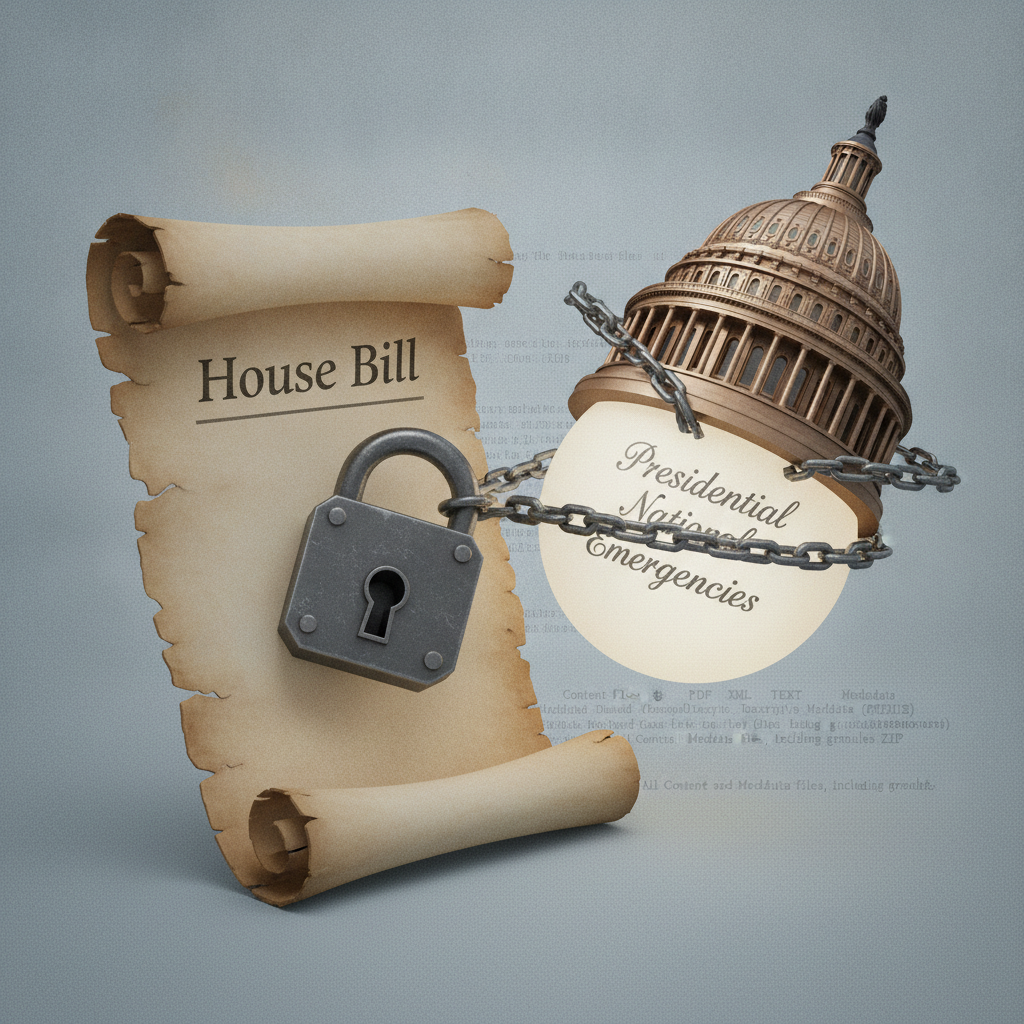
House Bill Aims to Reclaim Congressional Power Over Presidential National Emergencies
Content Files PDF XML TEXT Metadata download Descriptive Metadata (MODS) Preservation Metadata (PREMIS) All Content and Metadata files, including granules ZIP

Last updated:
Key points
House Bill Aims to Reclaim Congressional Power Over
- H.R. 10132 has been introduced in the U.S. House of Representatives to strengthen congressional oversight over presidential national emergency declarations.
- The legislation targets open-ended executive emergency powers by promoting required legislative approvals, strict reporting, and potential sunset timelines.
- Reforms aim to protect Article I constitutional authority, ensure transparent use of taxpayer dollars, and prevent perpetual emergency mandates.
NewsWK — Lawmakers in the United States House of Representatives have formally introduced legislation designed to restore constitutional checks and balances over executive authority during declared national emergencies. The measure, designated as H.R. 10132 and titled the Assuring that Robust, Thorough, and Informed Congressional Leadership is Exercised Over National Emergencies Act, seeks to recalibrate how emergency declarations are managed, reviewed, and sustained by the federal government.
Under the framework established decades ago, the executive branch possesses broad statutory authority to invoke dozens of emergency statutory powers upon declaring a national emergency. H.R. 10132 reflects a renewed, bipartisan interest on Capitol Hill to reassert Article I authority—the legislative branch’s constitutional mandate—by ensuring that ongoing emergencies require regular scrutiny and explicit congressional consent rather than continuing indefinitely without legislative intervention.
Why it matters here
For citizens and business owners across the United States, presidential emergency declarations are far more than procedural designations inside Washington. When a president declares a national emergency, hundreds of statutory provisions become available to executive agencies, allowing the administration to redirect congressionally appropriated funds, alter regulatory requirements, adjust trade controls, and enact rules that directly affect local economies and private property.
Historically, long-lasting national emergencies have expanded the scope of federal intervention in commerce, agriculture, healthcare, and state governance. When emergency powers operate on autopilot without legislative renewal, taxpayers bear the cost of executive-directed spending, while regional industries must navigate shifting mandates that bypass the traditional committee and floor debate process in Congress.
Reasserting congressional oversight ensures that any measure restricting commerce, reallocating federal tax dollars, or establishing emergency federal mandates receives direct review from the elected representatives accountable to local voters.
The Balance of Executive and Legislative Power
The U.S. Constitution grants the legislative branch the power of the purse and the authority to make laws, while the executive branch is tasked with enforcing them. Over the past half-century, however, Congress has increasingly delegated emergency authorities to the president to enable rapid responses to sudden crises, natural disasters, foreign threats, and economic turmoil.
The foundational statute governing this dynamic is the National Emergencies Act of 1976. While that law was initially enacted to rein in open-ended emergency powers following decades of executive overreach, subsequent legal developments—most notably the 1983 Supreme Court ruling in INS v. Chadha—weakened the mechanism Congress used to terminate emergency declarations. Under current law, terminating an emergency declaration requires passing a joint resolution that the president can veto, effectively demanding a two-thirds supermajority in both chambers to overturn an executive order.
Legislation like H.R. 10132 is crafted to address this structural imbalance by instituting clear sunset provisions and requiring affirmative congressional approval to extend emergency declarations beyond a predetermined time frame.
Key Focus Areas of Emergency Powers Reform
While the specific legislative text moves through the standard committee referral process in the House, proposals under this reform umbrella generally focus on several core pillars:
- Mandatory Sunsets: Setting strict expiration dates on presidential emergency declarations, typically requiring the president to secure affirmative approval from both the House and Senate within 30 to 60 days to keep the emergency authorities active.
- Transparency and Reporting: Requiring the White House and federal departments to submit comprehensive accounting reports detailing how emergency funds are spent and which specific statutory authorities are being deployed.
- Prohibiting Perpetual Crises: Preventing emergency declarations from lingering for decades without formal legislative reauthorization, thereby returning primary governing authority to the standard legislative process.
- Protecting Congressional Appropriations: Ensuring that executive agencies cannot unilaterally bypass congressional spending priorities or divert funding without explicit statutory permission.
Next Steps in the Legislative Process
H.R. 10132 has been introduced and referred to the appropriate House committees for formal consideration and debate. Before the bill can advance to the House floor for a full vote, lawmakers will examine its provisions, evaluate potential impact on national security and crisis management, and consider possible amendments.
Supporters of the legislation argue that restoring the balance of powers between the branches is essential to preserving constitutional governance, protecting individual liberties, and ensuring that significant policy shifts remain subject to the deliberation of the people’s elected representatives in Congress.
This article was produced with the assistance of AI and reviewed by our editorial team.
Sources
Related: Severe Thunderstorm Watch Issued for Bennington, Vermont as State Officials Urge Preparedness
Related: News That Works
Related: House Resolution Introduced Seeking Impeachment of Donald Trump
See a typo? Report it here.