California
How the AI Cyber Defense Act Protects American Infrastructure
Content Files PDF XML TEXT Metadata download Descriptive Metadata (MODS) Preservation Metadata (PREMIS) All Content and Metadata files, including granules ZIP


Last updated:
Key points
- Bipartisan lawmakers introduced the AI Cyber Defense Act (H.R. 10873) to protect U.S. infrastructure from cyber threats.
- The bill directs NIST to work with private AI companies to define voluntary security standards and prevent model theft.
- The legislation targets foreign entities from nations like China and Russia while avoiding mandatory government penalties for domestic firms.
NewsWK — Lawmakers in Washington introduced new bipartisan federal AI cybersecurity legislation to safeguard essential American systems. The proposal establishes voluntary standards to protect critical infrastructure and proprietary artificial intelligence models from foreign adversaries.
What is the AI Cyber Defense Act and who supports it?
The AI Cyber Defense Act, officially designated as H.R. 10873, represents a bipartisan effort in the U.S. House of Representatives. Representative Pat Harrigan, a North Carolina Republican, introduced the bill on October 22, 2026. Meanwhile, Representative George Whitesides, a California Democrat, co-sponsored the legislation.
The House Committee on Science, Space, and Technology will review the proposal. Rather than imposing government mandates or strict penalties, the bill relies on voluntary coordination between federal agencies and private enterprise.
How will H.R. 10873 protect critical infrastructure for local communities?
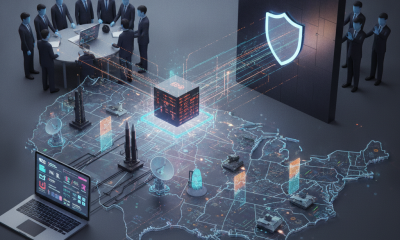
The measure directly addresses growing threats against vital civilian systems. Therefore, the National Institute of Standards and Technology will create an AI Cybersecurity Roundtable. The panel will help defend systems that keep local communities running safely by bringing together private AI creators and infrastructure operators.
For example, the panel will focus on securing essential services, including:
- Power grids and public utilities
- Hospitals and healthcare networks
- Financial institutions and banking networks
- Transportation systems and communications towers
What are NIST AI cybersecurity standards for AI distillation attacks?
NIST AI cybersecurity standards will address dangerous vulnerabilities like AI distillation attacks. In these attacks, an AI model is trained on the outputs and reasoning of another, more advanced model to replicate its capabilities. Consequently, the legislation targets foreign entities controlled by China, Russia, Iran, North Korea, and Cuba.
When will the new safeguards take effect?
The bill establishes strict schedules for federal agency action upon enactment. NIST must begin coordinating with private stakeholders within 180 days after the bill becomes law. Then, the agency must publish all completed voluntary standards on its public website within one year of development.
This article was produced with the assistance of AI and reviewed by our editorial team.
Sources
Related: U.S. House Advances National Defense Authorization Act for Fiscal Year 2027
Related: House Resolution 1499 Clears Way for Critical Votes on Mining, Higher Education, and Maritime Rules
See a typo? Report it here.