
Environment
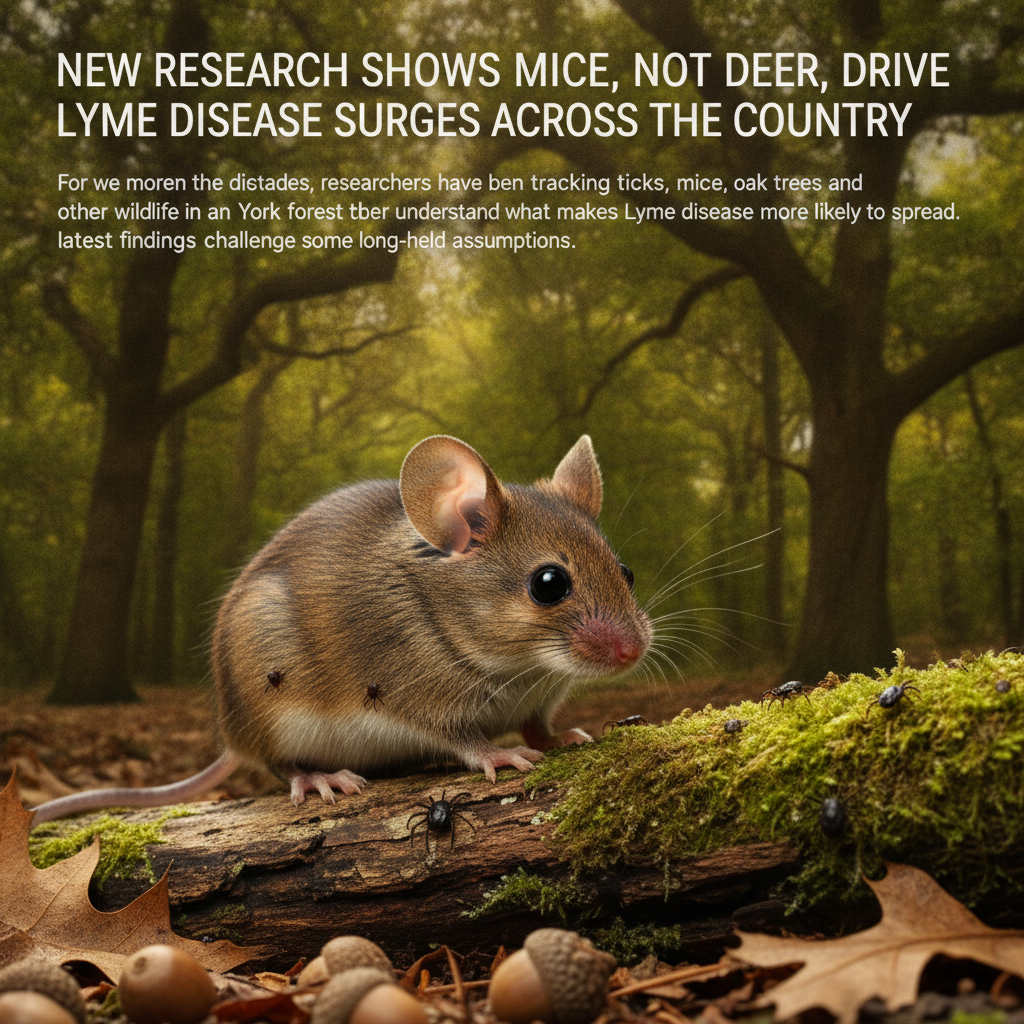
New Research Shows Mice, Not Deer, Drive Lyme Disease Surges Across the Country
For more than three decades, researchers have been tracking ticks, mice, oak trees and other wildlife in a New York forest to better understand what makes Lyme disease more likely to spread. Their latest findings challenge some long-held assumptions —…

Key points
New Research Shows Mice, Not Deer, Drive Lyme
- A 30-year study reveals white-footed mice, rather than deer, are the primary driver of blacklegged tick population spikes, with heavy mouse years sparking a 40% rise in nymphal ticks.
- Bumper acorn crops create a predictable two-year cycle that boosts rodent populations and subsequently drives up tick numbers.
- Tick resilience remains strong against extreme weather, while expanding lone star tick ranges have prompted at least 14 states to advance mandatory tracking for meat-allergy-inducing alpha-gal syndrome.
NewsWK — For decades, public health warnings and common wisdom have pointed to deer as the primary culprit behind the proliferation of Lyme disease. However, a landmark, decades-long ecological study is reshaping that understanding, demonstrating that small woodland rodents—specifically white-footed mice—serve as the chief engine fueling surges in disease-carrying ticks across the United States.
The findings, published in the Proceedings of the National Academy of Sciences, stem from more than 30 years of field research conducted by the Cary Institute of Ecosystem Studies. Tracking wildlife interactions across a 2,000-acre site in Dutchess County, New York, since 1991, researchers found that spikes in white-footed mouse populations directly correlate with significant increases in young blacklegged ticks, the primary life stage responsible for transmitting Lyme disease to humans.
According to the data, a bumper year for mice typically leads to an estimated 40% surge in nymphal ticks during the subsequent season. Furthermore, the researchers discovered that heavy autumn acorn crops create a predictable two-year chain reaction: abundant acorns provide a surplus food supply for mice, driving up rodent numbers the next year, which in turn leads to a noticeable jump in tick density two years after the initial acorn boom.
Why it matters here
Lyme disease remains the most prevalent tick-borne illness in the country, with federal health officials estimating that roughly 476,000 Americans are diagnosed and treated annually. For homeowners, agricultural producers, and outdoor enthusiasts, understanding what actually drives tick populations is critical for managing property risks, protecting families, and reducing the substantial medical costs associated with chronic and acute vector-borne illnesses.
While property owners and municipalities often focus their tick-mitigation efforts on deer exclusion fencing or culling, the Cary Institute’s findings suggest that rodent management, leaf litter cleanup, and habitat maintenance closer to the ground are far more influential in curbing immediate exposure risks in backyards and community parks.
Ecosystem Balance and Infection Dynamics
Interestingly, the research revealed that while high mouse numbers reliably predict higher total tick counts, they do not automatically lead to a higher percentage of infected ticks. White-footed mice are unusually efficient at passing the Lyme-causing bacterium to feeding larval ticks. However, other forest-dwelling wildlife—including skunks, opossums, and squirrels—frequently act as biological buffers.
Because these alternative hosts are less efficient at transmitting the bacterium, a diverse wildlife community can dilute the overall infection rate. Larval ticks that feed on opossums or squirrels are far less likely to pick up the pathogen than those feeding exclusively on mice, highlighting the role that natural predator-prey dynamics and wildlife diversity play in human disease risk.
Weather Resilience and Expanding Tick Threats
The study also delivered sobering news regarding weather resilience: blacklegged ticks are remarkably adept at surviving harsh conditions. Despite seasonal periods of severe winter cold or intense summer heat, wild ticks frequently survive by taking shelter deep within forest soil and moist leaf litter, debunking the belief that a hard winter frost will naturally eradicate local tick populations.
These ecological insights emerge at a time when tick populations and the diseases they carry are actively expanding into new regions of the United States. In addition to blacklegged ticks, the aggressive lone star tick—identifiable by the single pale spot on the back of adult females—has steadily moved beyond its historic southeastern stronghold into broad swaths of the Midwest, Northeast, and Mid-Atlantic.
Lone star ticks carry several distinct pathogens and are notably linked to alpha-gal syndrome, a serious condition that triggers an allergy to mammalian meat and dairy products. The Centers for Disease Control and Prevention estimates that as many as 450,000 individuals nationwide may be affected by the condition, though experts believe it remains significantly underdiagnosed due to a lack of uniform national reporting mandates.
State Policy and Surveillance Responses
In response to the growing health and economic burden of tick-borne conditions, state lawmakers across the nation are working to modernize their public health tracking systems. At least 14 states have enacted or are advancing measures to classify alpha-gal syndrome as an officially reportable medical condition, requiring diagnostic laboratories and healthcare providers to submit case data directly to state health agencies.
States such as Massachusetts, Missouri, and Oklahoma have recently expanded their official surveillance and public outreach efforts to better monitor these expanding vectors. In Ohio, state representatives approved legislation to make alpha-gal syndrome a reportable condition, sending the measure to the state Senate for consideration before the close of the legislative session.
As research continues to clarify the multi-year ecological cycles governing tick populations, public health specialists stress that early detection, accurate diagnostic tracking, and informed personal precautions remain the best defense for families working and recreating in the nation’s rural and suburban landscapes.
This article was produced with the assistance of AI and reviewed by our editorial team.