California
State Lawmakers Across Nation Push Nearly 250 Bills to Limit Federal Immigration Enforcement
Democratic lawmakers proposed nearly 250 bills in state capitols this year seeking to limit federal immigration efforts as they sought to push back against what they view as federal government overreach. In a new report tallying 2026 action, State Futures,…

Last updated:
Key points
limit federal immigration enforcement
- State lawmakers introduced 242 bills in 32 states aiming to limit federal immigration enforcement, with 53 measures passing in 17 states.
- Proposals include bans on agent face masks, restrictions on courthouse arrests, data confidentiality rules, and state health inspections of detention facilities.
- Several measures face legal challenges under federal preemption rules or vetoes from governors concerned about putting law enforcement officers in legal conflicts.
NewsWK — State lawmakers across the nation are increasingly utilizing state legislative authority to resist federal immigration enforcement, initiating a wave of legislation aimed at curbing operations led by federal authorities during President Donald Trump‘s second term. A national tally indicates that progressive legislators introduced 242 separate bills across 32 statehouses this year seeking to erect legal and administrative barriers to federal deportation efforts.
The legislative package, tracked by the policy group State Futures, has seen 53 bills successfully clear state legislatures across 17 states, though several face gubernatorial vetoes or ongoing judicial challenges. These bills range from banning face coverings for law enforcement officers to imposing state zoning and health inspections on federal detention facilities and prohibiting arrests near courthouses, public schools, and healthcare facilities.
Why it matters here
For citizens and local jurisdictions across the country, the surge in state-level opposition to federal immigration enforcement creates significant constitutional, financial, and operational challenges. When state legislatures enact laws attempting to insulate individuals from federal law enforcement, local police officers, sheriff’s deputies, and courthouse security personnel are placed in a precariously conflicted position. Frontline personnel face potential liability or disciplinary action if forced to choose between adhering to state enactments or respecting federal law enforcement mandates.
Moreover, state attempts to restrict federal agencies frequently lead to expensive constitutional litigation. When states defend these statutes against federal preemption challenges under the U.S. Constitution’s Supremacy Clause, local taxpayers bear the ultimate burden of defending laws that federal judges regularly strike down or enjoin. The resulting legal uncertainty can also weaken interagency cooperation required to apprehend violent offenders and maintain order in local communities.
Executive Vetoes and Judicial Hurdles
While progressive lawmakers have rallied around these state-level measures, several state chief executives—including prominent Democrats—have expressed strong reservations regarding their legal enforceability and practical consequences. In Virginia, Democratic Governor Abigail Spanberger vetoed a bill designed to prohibit immigration enforcement within courthouses, public schools, and hospitals. Spanberger warned in her veto message that the law would place local security personnel and law enforcement officers in the untenable position of having to choose between violating state rules or federal law.
Similar concerns are being evaluated in Delaware, where Democratic Governor Matt Meyer is weighing action on courthouse enforcement limits. Meanwhile, state-level restrictions have already encountered significant headwinds in the federal court system. In California, a federal judge blocked a state statute seeking to prohibit law enforcement officers from wearing identity-concealing face masks. The court ruled that because the statute specifically exempted state and local law enforcement while applying to federal personnel, it unlawfully discriminated against federal agents. In response to that ruling, legislators in Rhode Island introduced broader mask restrictions applying universally to all officers, though that proposal remained stalled in committee.
State Regulations on Federal Detention and Data Sharing
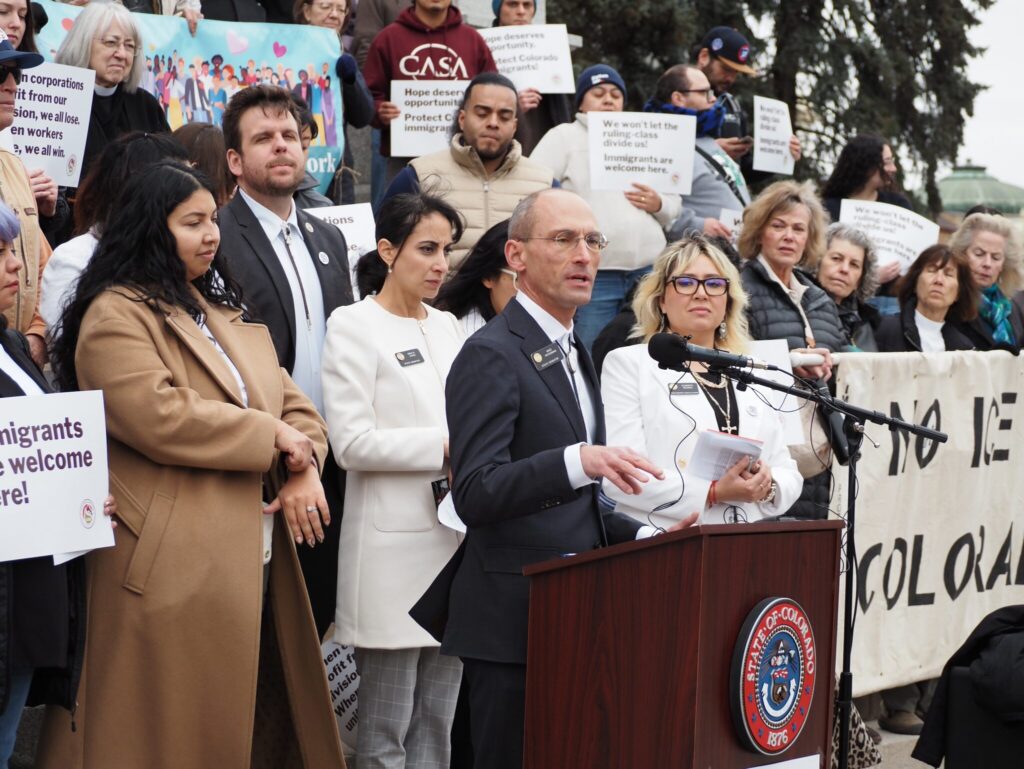
Beyond physical enforcement locations, several states have moved to exercise regulatory oversight over immigration detention infrastructure and administrative data. In Colorado, state lawmakers passed legislation granting the state health department expanded statutory authority to inspect private immigration detention facilities and enforce state public health standards. The state’s attempt to mandate compliance and force disclosure of health records—spurred in part by a reported tuberculosis case among detainees—has prompted active litigation from a private detention facility operator challenging the state’s regulatory authority over federal contractors.
Colorado Democratic state Senator Mike Weissman, who sponsored the oversight measure, emphasized the coordinated approach among state legislators, remarking that “we all talk because we all have the same concerns, and that is to protect the basic freedoms of our people from an absolutely out of control federal regime.”
In Oregon, Governor Tina Kotek signed a package of eight bills in April aimed at insulating immigrants from federal enforcement. The Oregon measures prohibit enforcement actions in sensitive areas, bar state agencies from sharing confidential data with federal immigration authorities, and establish legal pathways for individuals to bring civil suits against federal entities for alleged statutory violations.
A Strategic Shift Toward Federalism
The legislative campaign highlights a notable ideological shift in state capitol debates. Democratic lawmakers are increasingly invoking doctrines of federalism and state sovereignty—legal concepts historically emphasized by conservative legal scholars to limit federal overreach—to justify state-level resistance to federal policy.
Rhode Island state Senator Tiara Mack, who co-chairs a multi-state legislative working group for State Futures and sponsored a newly enacted Rhode Island law allowing civil lawsuits and contempt citations against improper courthouse arrests, acknowledged the political transition. “This new landscape requires legislators to really own the narrative and own the reality that federalism is something that we can use as a tool to strengthen protections for our state, and we have to work with states across the country,” Mack said.
As statehouses continue to push the boundaries of state authority against federal immigration powers, the resulting legal friction will inevitably require resolution by federal appellate courts, testing the constitutional limits of state interference in federal law enforcement.
This article was produced with the assistance of AI and reviewed by our editorial team.
Sources
Related: Can Balcony Solar Panels Lower Your Energy Bills? New State Laws Face Safety Hurdles
See a typo? Report it here.